Book Publishing Terms Every Expert Author Should Know

Book publishing terms
A B C D E F G H I J K L M N O P Q R S T U V W X Y

This glossary of book publishing terms is designed specifically for experts and thought leaders working with a professional publishing team.

A book is one of the most powerful authority-building tools available to an expert, executive, coach or thought leader. It opens doors, establishes credibility, and gives you something tangible to put in the hands of prospects, media and audiences.

But even when you’re working with a professional publishing team – and letting them handle the heavy lifting – understanding the language of publishing makes you a better collaborator. It helps you know what’s being done on your behalf, what you’re approving, and how each decision connects to your bigger goals: building your reputation, growing your business, and getting your ideas into the world in a way that reflects your expertise.

This glossary explains the key terms you are likely to encounter throughout the publishing process. You don’t need to master all of this – you just need enough to have informed conversations, make confident decisions, and get the most out of working with your publishing team.

Drawn from The Self-Publisher’s Amazon Playbook by Jane Tabachnick.

A

Algorithm

Amazon’s search algorithm determines which books appear in search results – and in what order – when someone searches on Amazon. Think of it as Amazon’s version of Google. A professionally optimized book listing is built to work with the algorithm, so your book gets in front of the right readers without you having to do anything extra.

A+ Content

Amazon A+ Content is an enhanced section of your book’s Amazon listing that goes beyond the standard description. It can include additional images, pull quotes, and formatted text – essentially a mini landing page within Amazon. For thought leaders and executives, it’s a valuable space to reinforce your credentials, communicate your book’s impact, and convert browsers into buyers.

ARC (Advance Review Copy)

An Advance Review Copy is an early version of your book distributed to reviewers, colleagues, endorsers, and influencers before your official publication date. The goal is to have reviews and endorsements ready the moment your book launches. For authority-driven authors, ARCs sent to respected peers and industry figures generate the kind of social proof that signals your book is worth reading before a single stranger weighs in.

Author Central

Amazon Author Central is the platform where your author presence on Amazon is managed. It’s where your Author Page lives, and it gives your publishing team the ability to add editorial reviews, update your biography, and access sales insights. Consider it your author headquarters on the world’s largest bookstore.

Author Page / Author Profile

Your Author Page on Amazon brings together your biography, photo, and all of your published books in one place. For experts and executives, a well-crafted Author Page reinforces your positioning and makes it easy for anyone who discovers one of your books to learn more about you and explore your broader body of work.

B

Best Seller Rank (BSR)

The Amazon Best Sellers Rank is a real-time indicator of how well your book is selling compared to others in the same category. Reaching #1 in a well-chosen category – even briefly – earns your book an official “Best Seller” badge that can be used in your marketing, on your website, in your speaker bio, and across your promotional materials. It’s a meaningful and recognizable credibility marker.

BISAC Codes

BISAC codes are the standardized subject categories the publishing industry uses to classify books – the system that determines where your book is shelved on Amazon and in libraries and bookstores. Your publishing team selects the codes that best match your content and audience, ensuring your book reaches the readers most likely to benefit from it.

Book Description

Your book description is the sales copy on your Amazon listing – the text that convinces a potential reader to buy. For an authority-driven book, it needs to go beyond summarizing content: it should speak to your ideal reader’s challenge or aspiration, establish your credibility quickly, and make a compelling case for why your perspective matters. Your publishing team will craft this to work both for readers and for Amazon’s search algorithm.

Book Layout Design

Book layout design is the interior formatting of your book – how text, headings, images, and spacing are arranged on the page. For executives and thought leaders, this matters more than people realize: a beautifully designed interior is one of the clearest visual signals of a professionally produced book. It’s the difference between something that reads like a polished business title and something that reads like it was assembled at home.

Book Listing Page

Your book listing page – also called your product detail page – is your book’s home on Amazon. Every element of this page works together to build trust and drive purchases: your cover, title, description, reviews, A+ Content, and author information. A professionally managed listing treats this page as the sales and credibility asset it truly is.

Book Reviews

Reader reviews are one of the most visible signals of a book’s credibility and quality on Amazon. For authority-driven authors, reviews aren’t just nice to have – they’re part of your professional reputation on the platform. A thoughtful pre-launch strategy, including ARCs and outreach to your network, builds the review foundation that supports both visibility and your broader promotional goals.

C

Categories

Amazon categories are the subject sections where your book is listed – the digital equivalent of bookstore shelves. Strategic category selection is one of the highest-leverage decisions in publishing: the right categories position your book to earn a Best Seller ranking, reach readers actively browsing your topic, and lend your listing a badge that travels well in marketing materials.

Cover Design

Your book cover is your most visible marketing asset. It’s the first thing people see on Amazon, at a speaking event, on your website, or in a media feature. For thought leaders and executives, a professional cover communicates authority and expertise at a glance – at thumbnail size on a screen and at full size in someone’s hands. A great cover signals that the content inside deserves attention.

Customer Reviews

Customer reviews are the star ratings and written feedback readers leave on your Amazon listing. They influence both potential buyers and Amazon’s algorithm. Building a genuine, positive review base – through strategic pre-launch outreach and ongoing reader engagement – is a core part of any professional book promotion strategy.

E

eBook

An eBook is the digital version of your book, readable on Kindle devices or the free Kindle app on any phone, tablet, or computer. For thought leaders, publishing an eBook alongside your print edition significantly extends your reach — it’s instantly available worldwide, easy to share, and enables promotional strategies like limited-time price reductions that can spike visibility and introduce your ideas to new audiences.

Editorial Reviews

The Editorial Reviews section of your Amazon listing is prime real estate for authority-building. Unlike customer reviews, you control this content entirely – it’s where you display endorsements from industry leaders, media mentions, and blurbs from respected figures in your field. For executives and thought leaders, a strong editorial review section signals that your work has been recognized beyond readers alone, which resonates with prospective clients, speaking bureaus, journalists, and collaborators.

G

Great on Kindle

Great on Kindle is an Amazon program that highlights high-quality nonfiction eBooks with enhanced reading features. Selection signals quality and provides additional visibility within Amazon – particularly relevant for nonfiction thought leadership books written by experts who want their ideas to reach as wide an audience as possible.

H

HTML for Amazon (Hypertext Markup Language)

Amazon allows specific formatting code in your book description and editorial reviews – bold text, bullet points, italics, line breaks, and more. Properly formatted listing copy is easier to read, more visually compelling, and more likely to hold a reader’s attention long enough to convert to a sale. Your publishing team handles this behind the scenes, but it’s one of the small details that adds up to a polished, professional listing.

I

Indexing

When your book is indexed on Amazon for a keyword, it means your book appears in search results when someone types that term. For example, if your book is indexed for “executive leadership” or “business growth strategy,” it surfaces in front of readers actively searching for books on those subjects. Indexing is shaped by your keywords, categories, title, and description – all elements your publishing team optimizes deliberately on your behalf.

ISBN (International Standard Book Number)

An ISBN is the unique 13-digit identifier assigned to your book – its official fingerprint in the publishing world. It’s required for distribution beyond Amazon, including bookstores, libraries, and wholesalers. For executives and thought leaders who want their name listed as the publisher, your team can register a custom ISBN through Bowker. It’s a small detail that affects how your book is perceived across the industry.

K

KDP (Kindle Direct Publishing)

Kindle Direct Publishing is Amazon’s publishing platform – the infrastructure through which your book is published, distributed, and sold on Amazon. Your publishing team works within KDP to upload your book, manage pricing, set categories and keywords, and handle the technical details of getting your book live and optimized. You don’t need to touch it directly; understanding it exists helps you follow what’s happening at each stage of the process.

KDP Select / Kindle Unlimited

KDP Select is an optional program that places your eBook in Kindle Unlimited – Amazon’s subscription reading service — in exchange for Amazon exclusivity during 90-day enrollment periods. It can increase readership and discoverability, particularly for nonfiction. Your publishing team will discuss whether this aligns with your distribution goals, especially if wide availability across multiple platforms is part of your strategy.

Keywords

Keywords are the search terms your publishing team enters when setting up your book – the bridge between what readers are searching for and your book appearing in those results. For thought leadership books, the right keywords connect your expertise directly to the problems your ideal audience is actively researching. They’re invisible to readers but essential to making sure the right people find your book.

Kindle

Kindle is both Amazon’s e-reader device and the format for digital books on Amazon. A Kindle edition of your book is immediately available to millions of readers worldwide – no shipping, no waiting. For thought leaders whose book is as much a business tool as a product, the Kindle edition is often the version that travels furthest and fastest.

M

Metadata

Metadata is the complete set of information that identifies and describes your book: title, subtitle, author name, publisher, publication date, ISBN, categories, keywords, and description. Think of it as your book’s digital identity. Well-crafted metadata is how Amazon – and the entire book industry – understands what your book is, who it’s for, and where it belongs. Your publishing team builds and optimizes this deliberately, because it shapes everything from search visibility to how your book is distributed across platforms.

O

Optimization

Book listing optimization is the process of ensuring every element of your Amazon listing is working as hard as possible – for discoverability, for credibility, and for conversion. For thought leaders and executives, an optimized listing also reflects your professional brand: it looks polished, communicates authority, and gives every potential reader, client, or media contact who lands on it immediate confidence that this is a serious, well-produced book.

P

Print on Demand (POD)

Print on demand means physical copies of your book are printed only when someone orders one – no warehouse, no upfront inventory investment, no boxes of unsold books. For executives and thought leaders, POD also means your publishing team can order author copies at cost in bulk for speaking events, client gifts, media outreach, and promotional use – always on demand, always available.

Professional Book Reviews

Professional book reviews come from credentialed reviewers at recognized publications, literary services, or media organizations. They carry a different weight than reader reviews – they indicate your book has been evaluated by the industry. For thought leaders pursuing media coverage, speaking opportunities, or positioning as a subject matter authority, professional reviews are a meaningful addition to your book’s promotional profile.

Publisher

When you work with a professional self-publishing service, your book is published under your name – you retain ownership and creative control, while your publishing partner manages the process. You are the publisher. The answer to “who published your book?” is you – with expert support. That model is increasingly the choice of executives and thought leaders who want the quality of traditional publishing with the control and speed of independent publishing.

R

Royalties

Royalties are the earnings you receive from each sale of your book. On KDP, eBook royalties can reach 70% of the list price, and print royalties are based on your price minus production costs. For most thought leaders and executives, the direct revenue from book sales is secondary to what the book generates indirectly – new clients, higher speaking fees, media opportunities, and a level of credibility that opens doors no business card ever could.

S

Subtitle

Your subtitle is the line beneath your title on your Amazon listing – and one of the most powerful authority and discoverability tools in publishing. A strong subtitle tells your ideal reader exactly what the book will do for them, while embedding the search terms most likely to connect your expertise with the people looking for it. For executives and thought leaders, a well-crafted subtitle also functions as a positioning statement – it defines your niche and your promise in a single line that appears everywhere your book does.

T

Trim Size

Trim size is the physical dimensions of your printed book – its width and height when closed. Standard sizes carry genre and market expectations: a 6×9″ trim reads as a serious business or professional title; a smaller size feels more personal. Your publishing team will recommend a trim size that fits both your content and how you want your book to be perceived on a shelf, in a speaker’s hands, or in a client’s office.

Your book is one of the smartest investments you can make in your brand. For experts, executives, coaches, and thought leaders, a professionally published book doesn’t just generate sales – it opens doors, elevates your speaking profile, attracts ideal clients, and establishes you as the go-to authority in your field.

Understanding these book publishing terms means you can engage confidently with your publishing team, make informed decisions at every stage, and recognize all the ways your book is working for you long after launch day.

Ready to publish your book with the support of a professional team? Let’s talk. 

Want to go deeper? Grab your copy of The Self-Publisher’s Amazon Playbook  

How to Turn Your Expertise Into a Nonfiction Book

Turn Your Expertise Into a Nonfiction Book

Turn Your Expertise Into a Nonfiction BookTurning your expertise into a nonfiction book starts with recognizing that your knowledge already has value – the challenge is structuring it into something readers can use, trust, and act on. A nonfiction book built from real expertise doesn’t just share information – it positions you as a trusted authority, generates leads, opens speaking and media doors, and works for your business long after it’s published.

This guide walks you through the process from idea to published book, based on years of working with consultants, coaches, and entrepreneurs who’ve made the leap from expert to author.

Why Your Expertise Deserves a Book

You don’t need to be famous to write a book. You need to have helped real people solve real problems. If you’ve built systems that work, developed frameworks your clients rely on, or spent years mastering something most people struggle with, you already have the foundation for a nonfiction book.

A book is a credibility engine. It shows up in search results, positions you as a thought leader, and gives readers one-on-one time with your voice and insights before they ever speak to you directly. In a world of rising skepticism and AI-driven discovery, nothing builds trust faster than being a published author. Your book signals long-form, structured expertise – the kind that unlocks media quotes, podcast spots, speaking invitations, and the kind of citations that AI systems recognize and amplify.

Beyond the business case, writing a book transforms you internally. It builds resilience, teaches you to ask for support, and puts you in an uncomfortable-but-growth-inducing spotlight. Becoming an author is like joining an exclusive club – and stepping into that circle, while terrifying, is something you won’t regret.

Step 1: Clarify Your Book Idea Before You Write a Word

The most common mistake aspiring authors make is diving straight into writing. Before you type a single sentence, you need clarity on three things: what your book is about, who it’s for, and why it matters.

Any topic can be turned into a book. But knowing whether your idea has a market – and aligns with your business goals – is essential. Many aspiring authors come to me with a tangle of ideas and aren’t sure which one to write, or they have loose concepts but don’t know how to connect them cohesively.

This is where a Book Blueprint comes in. Before writing a single word, bestselling authors create a book proposal – and for self-publishers, the equivalent is a Book Blueprint. This foundational document covers your book’s purpose, ideal reader, competitive positioning, and a strong outline. It eliminates writer’s block and gives you a clear roadmap to follow from start to finish.

In my work with authors, we use the Book Blueprint process – the same process used by New York Times and USA Today bestselling authors – to get complete clarity before any writing begins. Participants who walked in unsure have walked out with clarity, direction, and excitement about the book they’re going to write.

👉 Learn more about the Book Blueprint process

Step 2: Define Your Ideal Reader

A nonfiction book that tries to speak to everyone ends up resonating with no one. The more precisely you define your ideal reader, the more powerful your book becomes.

Using tools like Answer The Public, client interviews, and careful listening, you can capture your reader’s exact language, fears, and desires – then speak directly to them. That deep resonance is what turns readers into raving fans and pre-sells them on working with you.

Think about the transformation your reader will experience. Business books that succeed typically solve one clear problem for a specific audience. Instead of writing broadly about your entire field, focus on the one thing you can help your reader achieve – and build every chapter around getting them there.

Your clients are the recipients of your expertise and knowledge, so start with them. What questions do they ask you most often? What problems do they bring to you again and again? Those patterns are the skeleton of your book.

Step 3: Choose the Right Book Format

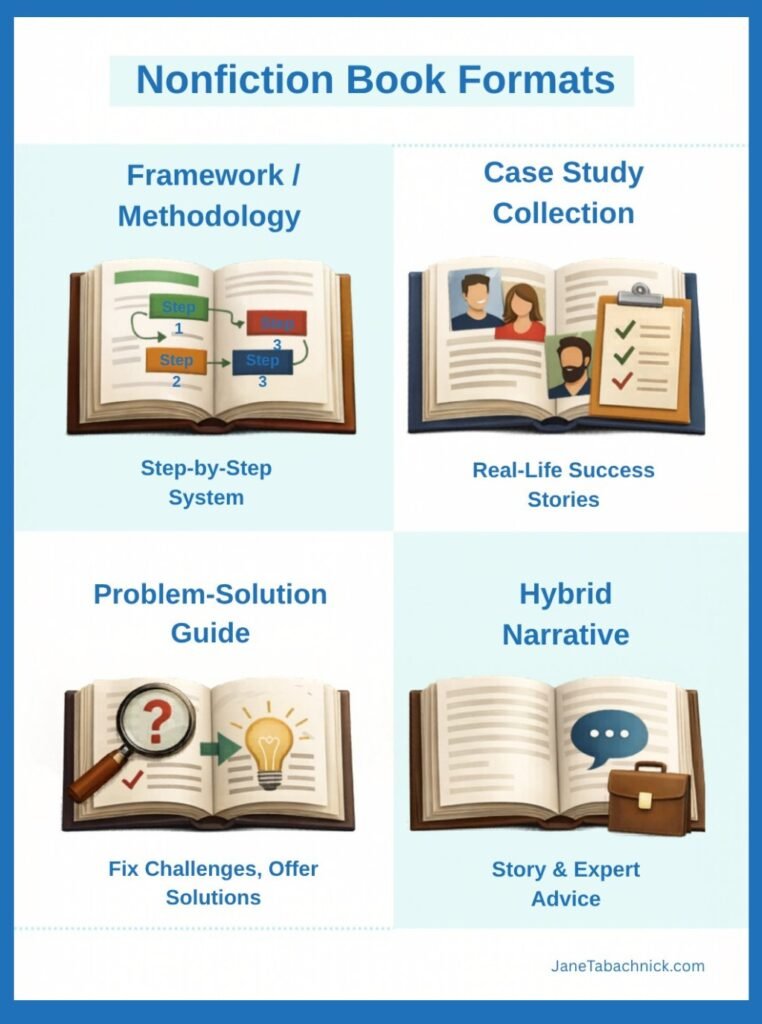
nonfiction book formats

A methodology doesn’t have to be twelve chapters. Your book could be a parable, a case study collection, a step-by-step guide, or even a short fifty-page book.

The right format aligns with your zone of genius, your reader’s needs, and feels the least like labor to create.

Here are the most common nonfiction formats for expertise-based books:

  • Framework or methodology book – walks readers through your proven system step by step.
  • Case study collection – demonstrates your approach through real client stories and outcomes.
  • Problem-solution guide – addresses the top challenges your audience faces with actionable solutions.
  • Hybrid narrative – blends personal story with professional insight and practical advice.

The format you choose should match both your natural communication style and your reader’s preferred learning style. Some audiences want a linear roadmap. Others want to see themselves in stories before they trust the advice.

Step 4: Build Your Outline and Write Strategically

With your idea clarified, your reader defined, and your format chosen, it’s time to build a detailed outline. A good outline breaks the entire project into manageable pieces and makes the path forward feel doable.

Having a plan reduces overwhelm and stress – and prevents the wandering, unfocused drafts that kill momentum.

Your outline should cover the transformation arc from where your reader starts to where they end up. Every chapter should serve a clear purpose within that arc. If a chapter doesn’t move the reader closer to the promised transformation, it doesn’t belong.

Here are a few strategic writing principles that make expertise-based books stronger:

  • Include stories. Stories are how our brains are wired to learn and remember. Including well-chosen client stories in your nonfiction book demonstrates your methodology in action, provides social proof, and helps readers see themselves in your work and imagine the transformation you can create for them.
  • Find your voice. Every author has a unique voice – the challenge is finding and trusting it. Your author voice is your fingerprint in writing. Know your audience, write regularly, be authentic, include personal stories, and don’t be afraid to share your opinions. The most powerful books make readers feel like they were written just for them, which requires depth, honesty, and genuine empathy.
  • Write useful books. Treat your book like a product. Gather reader feedback early, share behind-the-scenes of the process, and iterate based on what readers actually need. Books built with readers get recommended. Books written in isolation often miss the mark.

Step 5: Don’t Write Your Book Alone

Going solo on your book has hidden costs: lost time, frustration, burnout, and unfinished manuscripts. Many authors start strong and stall out – not because the idea is weak, but because the process is isolating and overwhelming without the right support.

My client Frederica Peterson, a leadership and diversity consultant, knows this firsthand. She had the expertise and the drive, but spent time going in circles trying to get her book done on her own. Once we started working together, everything shifted.

Thanks to the structure, strategy, and guidance we built around her project, Frederica’s book is now used as a tool in a training program at AT&T, she’s been tapped as a top trainer by the Tony Robbins organization, and she’s become a sought-after thought leader in her field. As she puts it:

“Jane’s knowledge in this arena is exceptional and her excitement genuine. I wanted very much to have a #1 best-seller and with Jane’s help and guidance we achieved that goal!”

I’ve experienced the power of community and coaching firsthand myself – not with a book, but with building a technical product that required building a funnel with an automation sequence. Twice now, I’ve joined a group coaching program and formed a mini cohort with other participants.

That small group provided accountability, honest feedback, friendship, and camaraderie – and when it came time to launch, they became my built-in launch team.

I wouldn’t have finished either project without that structure and support.

Writing a book works the same way. The authors I work with who finish fastest and produce the strongest books are almost never the ones who go it alone.

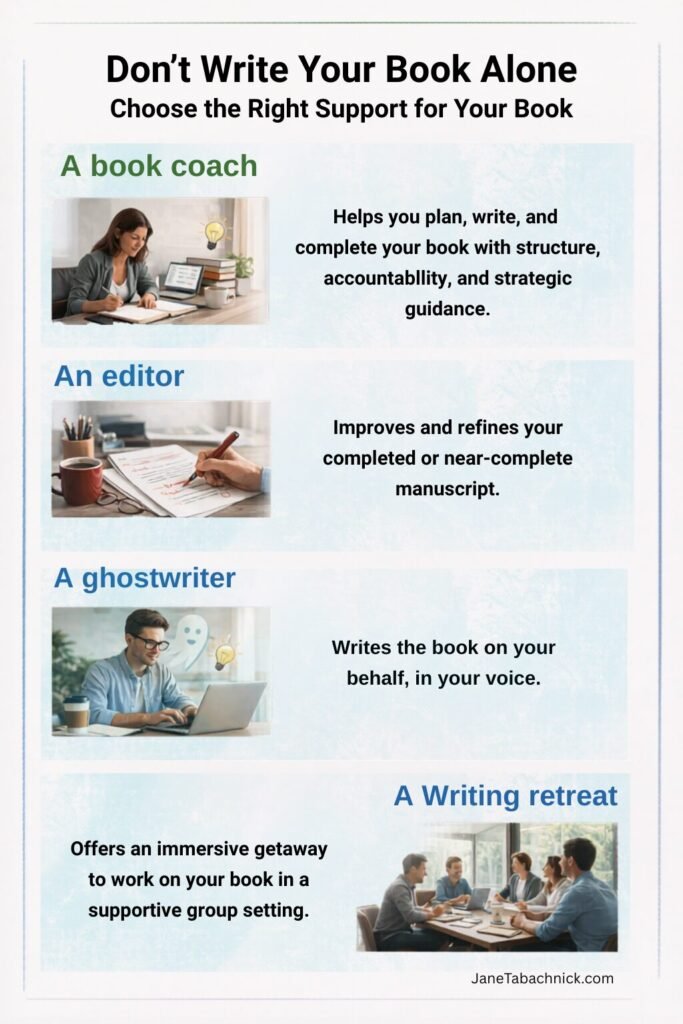
There are several types of author support available, and understanding the difference matters:

Don't write your book alone_choose the right support for your book

  • A book coach helps you plan, write, and complete your book with structure, accountability, and strategic guidance.

Some coaches focus only on the manuscript. Others – like my approach – cover the full journey from idea through publishing, launch, and positioning your book as a business tool.

  • An editor improves and refines a completed or near-complete manuscript.

Many authors benefit from a coach first, then an editor once the draft is complete.

  • A ghostwriter writes the book on your behalf, in your voice.

This is ideal for experts who have the knowledge but not the time or desire to write it themselves.

  • A Writing retreat is an immersive experience where you step away from your daily routine to focus entirely on your book with expert guidance and a small group of fellow authors.

Retreats build accountability, spark breakthroughs, and create an instant community that often becomes your launch team.


👉 Explore Jane’s book coaching services

Step 6: Think About Marketing Before You Finish Writing

Most authors disappear during writing, then surface two weeks before launch, asking for shares – and that approach rarely works. A book launch is not an event. It’s the outcome of months of relationship-building.

Here are pre-launch marketing actions to take while you’re still writing:

  • Build your email list. Start collecting readers and supporters now, not after the book is published. Organize them into lists, so they are ready for your launch when your book is completed.
  • Nurture relationships early. Top podcasts book guests five or more months out. Start building relationships with journalists, podcast hosts, influencers, and peers while you’re still drafting chapters.
  • Organize your contacts. Create a media list and a list of potential launch partners well in advance.
  • Claim your author identity now. You don’t have to wait until your book is published to call yourself an author. If you’re writing, you already are one. Claiming the identity early and speaking about it shifts your mindset, builds community, and invites speaking and podcast opportunities before the book is even out.

Something surprising happens when you publicly commit to writing your book: opportunities start finding you. Podcast invites, speaking gigs, and new connections tend to flood in. Declare your intention publicly, and watch the momentum build before the book is even finished.

Step 7: Publish Strategically

Anyone can upload a file to Amazon, but publishing professionally is far more nuanced. The publishing path you choose should match your goals, your timeline, and the experience you want your reader to have.

The main publishing paths for nonfiction authors include traditional publishing, hybrid publishing, and self-publishing in various forms – from DIY to professional self-publishing with a full team behind you. Each comes with different tradeoffs in terms of cost, control, time, and quality. The right choice depends on how you value your time, how much guidance you need, and what result you’re aiming for.

Whatever path you choose, don’t overlook discoverability. Your book’s metadata – title, subtitle, categories, keywords, and description – determines whether readers find you. Amazon optimization is critical, and knowing what to focus on makes all the difference for author success.

And remember: your book is a business asset, not a bestseller competition. For most nonfiction authors, especially entrepreneurs, consultants, and coaches, the real return on a book isn’t measured in copies sold. It’s measured in the client leads it generates, the speaking opportunities it opens, the media exposure it creates, and the consulting engagements it attracts.

Step 8: Position Your Book as an Authority Asset

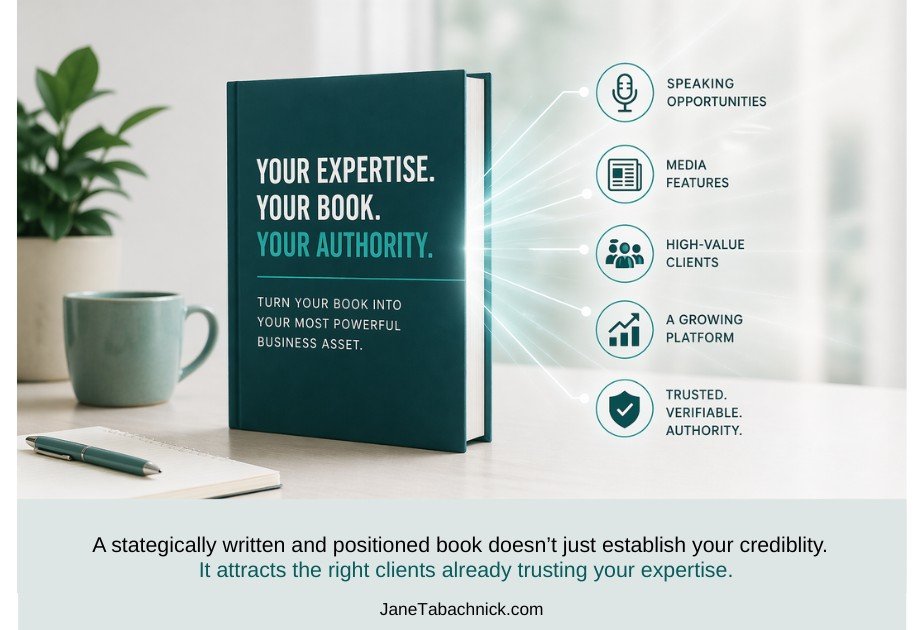
a strategically written bookA book isn’t just a product – it’s one of the most powerful authority assets you can create. When your book is strategically built from the ground up, it becomes a calling card that opens doors long after it’s published: media opportunities, speaking engagements, high-value client relationships, and a growing platform.

In an AI-driven world, being a trusted result is far more valuable than simply being visible. AI search favors trusted, verifiable, well-cited sources – and authors benefit enormously. A published book signals the kind of structured expertise that AI systems recognize and amplify, making you more discoverable in the very search environments where your ideal clients are looking.

The difference between a book that collects digital dust and one that actively builds your business almost always comes down to strategy. Every book I work on goes through a process I call Seeding the Content – a deliberate strategy to ensure your book functions as a powerful marketing tool, not just a well-written read.

A strategically written and positioned book doesn’t just establish your credibility. It creates a steady stream of leads who arrive already trusting your expertise. That’s the kind of book worth writing.

Ready to turn your expertise into a book that builds your business?

Work With Jane Tabachnick

Frequently Asked Questions

How do I know if my expertise is enough for a book?

If you’ve helped real people solve real problems and have frameworks, methods, or insights that others rely on, you have enough for a book. You don’t need decades of experience or a PhD – you need a clear message and a defined audience.

How long does it take to write a nonfiction book?

Most nonfiction authors working with a coach complete their manuscript in six to twelve months, depending on their availability and the complexity of the topic. Having a clear Book Blueprint and accountability support significantly reduces the time most authors spend stuck or starting over.

Should I self-publish or pursue traditional publishing?

It depends on your goals. Self-publishing offers speed, control, and higher royalties. Traditional publishing offers prestige and distribution but slower timelines. Many nonfiction authors – especially those using their book as a business tool – find that professional self-publishing gives them the best combination of quality and control.

Do I need to be a good writer to write a book?

Writing is a skill built through practice, not natural talent. You can develop your writing through the process itself, work with a writing coach, or hire a ghostwriter. The most important thing is that your expertise and ideas come through clearly.

How do I turn my book into business results?

Build your book strategically from day one – with your ideal client, your business goals, and your positioning in mind. A book that’s written as an authority asset generates leads, speaking opportunities, media coverage, and client trust that far exceed its sales revenue.

Can I start marketing my book before it’s finished?

Yes – and you should. Building your email list, nurturing relationships, creating a media list, and claiming your author identity while you’re still writing gives you the momentum you need for a successful launch.

What’s the difference between a book coach and an editor?

A book coach helps you plan, write, and complete your book with structure, accountability, and strategic guidance – often covering the full journey from idea through launch. An editor improves and refines a manuscript that’s already written. Many authors work with a coach first, then an editor.

Do You Need a Book Coach? How to Decide

Do you need a book coach?
Do you need a book coach?A book coach is a professional who helps authors plan, write, and complete a book. But the scope of what a book coach actually covers varies widely.Some focus specifically on the manuscript – helping you develop your content and get a draft ready to hand off to an editor or publisher.

Others guide you through much more of the journey, from idea development through publishing, launch, and beyond.

If you’ve been wondering whether a book coach is right for you, this guide covers what they do, how to decide if you need one, and how to find the right fit for your goals.

What Is a Book Coach?

A book coach helps authors plan, write, and finish a book by providing structure, accountability, feedback, and strategic guidance. Unlike editors, who focus on improving a finished manuscript, a book coach guides the process from the start – clarifying your idea, building your outline, and helping you complete your manuscript. Some book coaches also offer publishing support and help you plan your book launch.

👉 Learn more about Jane’s book coaching services

What Does a Book Writing Coach Actually Do?

A book coach can support, inspire, and help you achieve your goal of being a successful, published author – but not all book coaches are created equal. Some focus strictly on helping you get the words on the page. Others help you write and self-publish, but without much thought to how the book fits into your bigger picture.

Some book coaches take a true end-to-end approach, treating your book as both a great piece of standalone content and a strategic tool for building your business and authority. This last category is especially relevant for nonfiction authors who want their book to do more than sit on a shelf.

The difference matters. Book coaches bring different skill sets, experiences, and service offerings, so it’s essential to find out their background and what is covered under their “book coaching” services or programs before you commit. For example, my approach covers the full journey – from clarifying your book idea and vetting it against your business goals, through writing and publishing, to launch strategy and positioning your book as a tool for attracting clients, speaking opportunities, and media. Not every author needs all of that, but knowing what’s available helps you choose the right fit.

Here is a closer look at what a full-service book coaching engagement can include:

Idea and Book Strategy

A common refrain from aspiring authors is that they have a lot of book ideas and aren’t sure which one to write, or they have some loose ideas but don’t know how to connect them into a cohesive whole. A book coach helps you clarify your message, identify your target reader, and position your book so it aligns with your business goals. Any topic can be turned into a book, but knowing whether your idea has a market – and fits your bigger vision – is essential.

Book Structure and Outline

Once your idea is solid, a book coach helps you organize your thinking into a clear structure. That means building out chapters, creating a logical flow, and giving you a roadmap that prevents writer’s block. A good outline breaks the project into manageable pieces and makes the path forward feel doable. Having a plan reduces overwhelm and stress.

Accountability and Momentum

Many books fail not because the idea is weak, but because the author loses momentum. Without structure and deadlines, it’s easy to get sidetracked and abandon the project entirely. A book coach keeps you moving – setting milestones, checking in regularly, answering your questions, talking you off a ledge when you need it, and serving as your biggest cheerleader.

Publishing and Launch Strategy

Great content is essential, but you need more than just a finished manuscript to get your book in front of your ideal readers. You’ll want to know whether your coach helps you set author goals and create a strategy to achieve them, or whether you’ll need to tackle that on your own.

While anyone can self-publish a book, there is a sizeable learning curve. Rather than take time away from your zone of genius, a book coach can be your professional guide and help you craft a professional product that attracts ideal clients.

Beyond writing, the right book coach will also help you think about your authority positioning – how your book connects to your media presence, speaking opportunities, and the clients you most want to attract. That strategic layer is what separates a book that sits on a shelf from one that actively grows your business.

What sets my approach apart is a background that most book coaches simply don’t have. With roots in both PR/marketing and design, I’m always thinking beyond the manuscript. Every book I work on goes through a process I call Seeding the Content – a deliberate strategy to ensure your book functions as a powerful marketing tool, not just a well-written read.

And because I came up as a fashion designer, I bring an eye for visual quality that shows up in every book I produce. Time and again, my clients’ books are mistaken for titles from major publishing houses – and that’s exactly the point.

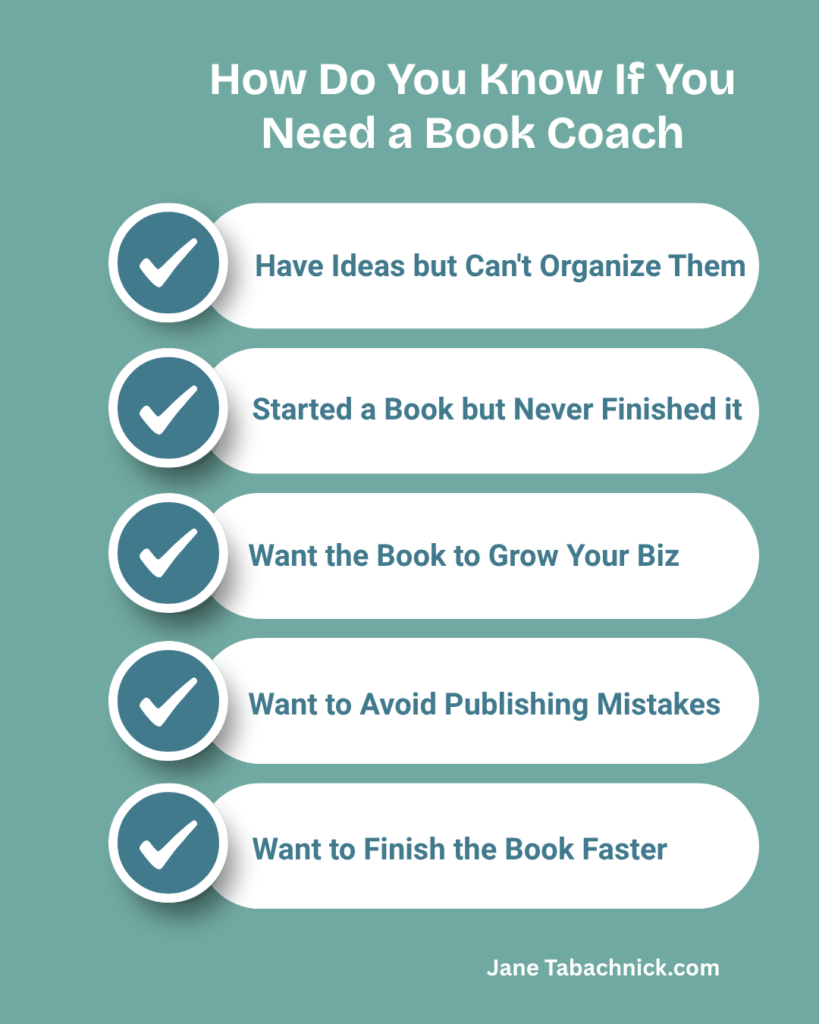
How Do You Know If You Need a Book Coach?how do you know if you need a book coach

If you’re unsure whether a book coach is right for you, consider whether any of the following situations sound familiar.

You Have the Idea but Can’t Organize It

You know you have something to say, but every time you sit down to write, the ideas feel scattered. You aren’t sure how to connect your thoughts into a cohesive structure or which angle to lead with. A book coach helps you get clarity and build a framework so the writing process flows naturally.

You Started a Book but Never Finished

Even the most successful people run into mindset issues when they think about writing a book and putting themselves out there. A coach can help you identify and move past those blocks so they don’t derail your author dreams.

If you’ve opened the same document a dozen times and closed it without adding a word, you’re not alone – and you’re not stuck forever. A book coach gives you the structure and accountability to move forward consistently, even when motivation fades.

You Want the Book to Grow Your Business

A strategically written book doesn’t just establish your credibility – it generates leads, opens doors to speaking engagements, and positions you as the go-to expert in your field. Many aspiring authors come to me and say they are ready to be more visible and scale their business. If business growth is the goal, your book needs to be built with that in mind from day one.

You Want to Avoid Publishing Mistakes

The publishing process has a steep learning curve. From formatting and cover design to distribution and launch timing, there are many places where first-time authors make costly errors. A book coach can help you sidestep those pitfalls – and some coaching packages include book layout and design services or can direct you to better hires, saving you from expensive do-overs.

The Benefits of Book Coaching

You Finish Your Book Faster

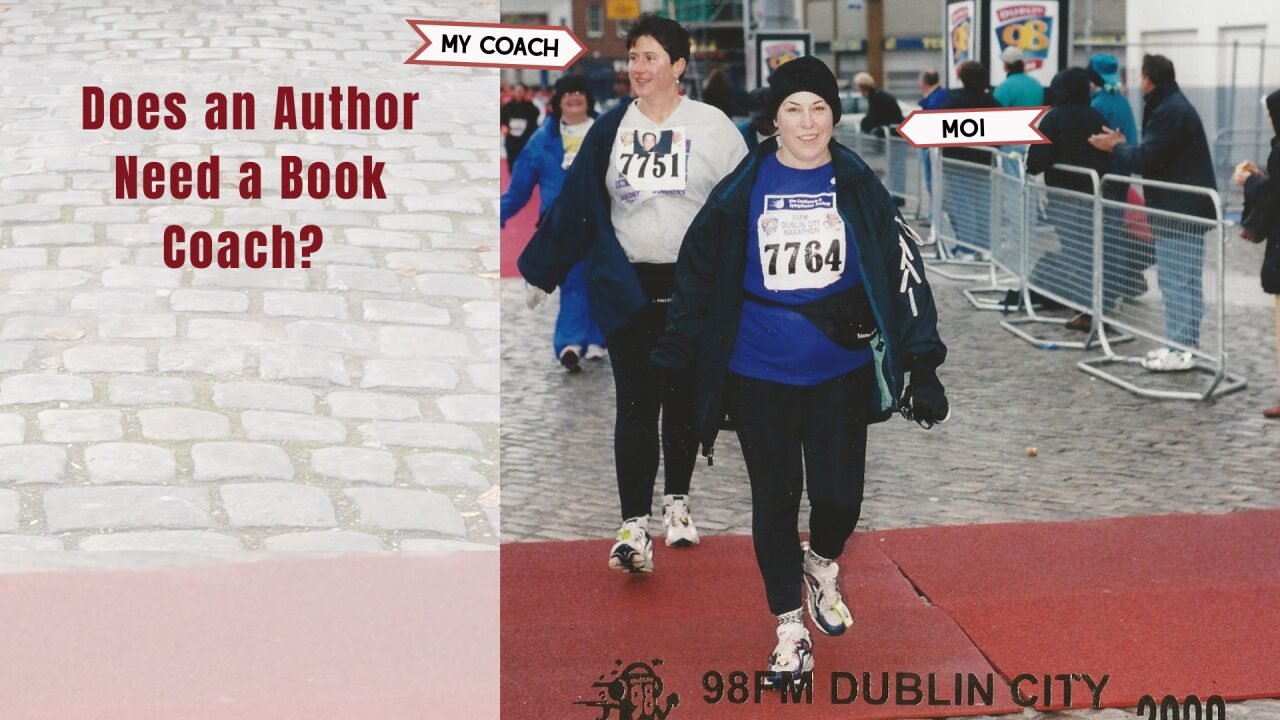
I’m not an Olympian – not even close. When I decided to train for a marathon, I knew I needed help. I’m the gal who is sometimes allergic to exercise. I even got a doctor’s note to get out of the gym one semester in high school. My good intentions to train for and complete a marathon could easily have been sidetracked and abandoned.

Joining Team in Training [TNT], The Leukemia & Lymphoma Society’s excellent program that offers professional sports training in exchange for fundraising efforts, was the best thing I did for myself. They even sent a coach with me for the race – no easy task, as there was an ice storm. Honestly, I wouldn’t have completed the Dublin Marathon without their training and support.

The same is true for writing a book. With a coach in your corner providing structure, deadlines, and encouragement, most authors finish their manuscript significantly faster than they would working alone.

You Get Professional Feedback Early

One of the most valuable things a book coach provides is expert feedback before you’ve gone too far down the wrong path. Rather than completing a full draft only to discover your structure isn’t working or your audience isn’t clearly defined, you get course corrections early – when they’re easiest and least costly to make.

Your Book Has a Clear Audience and Purpose

A good book coach helps you craft a clear and compelling vision for your author journey so that every chapter serves your reader and your goals. In my work with authors, we use the Book Blueprint process – the same process used by New York Times and USA Today bestselling authors – to get complete clarity on the book you want to write, who it’s for, and why it matters before you write a single word. It’s one of the most powerful things you can do to set your book up for success.

👉 Learn more about the Book Blueprint process

You Turn Your Book Into an Authority Asset

A book isn’t just a product – it’s one of the most powerful authority assets you can create as an entrepreneur or consultant. When your book is strategically built from the ground up, it becomes a calling card that opens doors long after it’s published: media opportunities, speaking engagements, high-value client relationships, and a platform that continues to grow.

The difference between a book that collects digital dust and one that actively builds your business almost always comes down to strategy. The PR and marketing lens I bring to every project means your book is being built as a business tool from page one – not retrofitted into one after the fact.

Are Book Coaches Worth It?

Do people complete the Olympics, marathons, and write books without coaches? Sure.

But consider this: many elite and Olympic athletes have coaches, and some have multiple coaches – nutritionists, mental performance coaches, and more. Major league baseball teams have an entire coaching staff: bench coach, hitting coach, strength and training coach, and beyond.

“If you want to be successful, find someone who has achieved the results you want and copy what they do, and you’ll achieve the same results.” – Tony Robbins

The value of a book coach goes beyond simply finishing your manuscript. It’s the time you save by not going in circles, the clarity you gain about your message and audience, the quality of the final product, and the strategic positioning that make your book work for your business long after publication. For authors who are serious about results, that return on investment is hard to argue with.

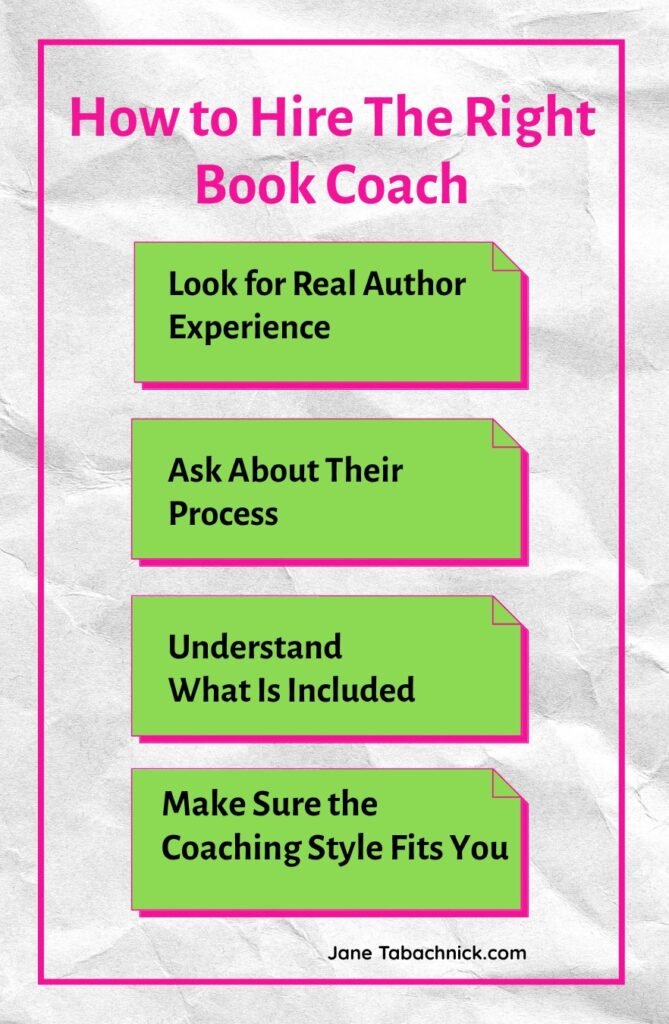
How to Hire the Right Book Coach

how to hire the right book coach

Look for Real Author Experience

Book coaches bring different skill sets and experiences to their work. Look for someone who has not only coached authors but has navigated the publishing world themselves. Ask whether your prospective coach thinks about your book as a marketing asset – not just a manuscript.

A background in PR, marketing, or design isn’t standard in the book coaching world, but it can make an enormous difference in the final product and how hard that product works for your business.

Ask About Their Process

A good coach should be able to walk you through exactly how they work and what you can expect at each stage. It’s essential to find out what is covered under their “book coaching” services or programs – so you’re clear on the structure before you begin.

Understand What Is Included

Some coaches focus on writing support only, while others include strategy, publishing guidance, and launch planning. If you want help beyond the manuscript, make sure that’s explicitly part of what’s on offer – don’t assume it’s included.

Make Sure the Coaching Style Fits You

Beyond credentials and process, fit matters. You’ll be spending months working closely with your coach, so it’s worth paying attention to how they communicate, whether they listen as much as they talk, and whether their style brings out the best in you.

Some authors thrive with a direct, structured approach. Others need more encouragement and creative space. Before committing, ask yourself: Do I feel heard in this conversation? Do I feel more confident or more overwhelmed? A good discovery call will tell you a lot. Trust what you notice.

How Much Does a Book Coach Cost?

Book coaching investment varies widely depending on the coach’s experience, what’s included in their program, and the level of support you need.

At the lower end, you’ll find coaches who offer standalone sessions or limited packages for a few hundred dollars. At the higher end, full-service coaching programs – particularly those that include strategy, accountability, publishing guidance, and launch support – can range from several thousand dollars upward.

Here are the key factors that affect pricing: experience and track record, scope of services (just writing support or also publishing strategy, design direction, and launch planning), length of engagement, and whether editing or detailed manuscript feedback is included.

It’s also worth remembering that working with the right coach can save you money in the long run by helping you avoid mistakes that require expensive do-overs.

What Is the 70/30 Rule in Coaching?

The 70/30 rule is a guiding principle in effective coaching: the client speaks about 70% of the time, while the coach listens, asks questions, and offers focused guidance about 30% of the time. The idea is that real breakthroughs happen when the client does the thinking – the coach simply creates the conditions for clarity.

In book coaching, this principle shows up naturally. You’re the expert on your ideas, your story, and your business. My job isn’t to hand you a formula – it’s to ask the right questions so you uncover what your book is really about, who it’s for, and why it matters. The answers are usually already inside you. A good book coach helps you find them.

Is Selling 3,000 Copies of a Book Good?

For most nonfiction authors, especially entrepreneurs, consultants, and coaches, selling 3,000 copies is a genuinely strong result – and most traditionally published books never reach it.

But here’s what I tell my clients: for business authors, raw sales numbers are rarely the most important metric. Your book is a business asset, not a bestseller competition. The real return on a nonfiction book looks like a corporate client who found you through your book and hired you for a consulting engagement, a keynote speaking invitation because an event organizer read your work, a podcast or media appearance that brought you in front of thousands of ideal clients, and a steady stream of leads who arrive already trusting your expertise.

When a book is written strategically – with the right message, the right audience, and the right positioning – 3,000 readers who are exactly the right people can transform your business. That’s the kind of book I help my clients write.

Book Coaching vs. Editing vs. Ghostwriting

One of the most common questions I hear is: “Do I need a book coach, an editor, or a ghostwriter?” The answer depends on where you are in your process and what kind of support you actually need.

ROLE PRIMARY FOCUS WHEN YOU NEED THEM WHAT THEY DON’T DO
Book coach Strategy, structure, accountability, and the full author journey From day one – before you write a single word Write the book for you – though some coaches also offer editing services
Developmental editor Shaping your idea, structure, argument, and overall flow Early to mid process – before or during writing, not just at the end Provide the ongoing accountability and strategy of a full coaching relationship
Copy editor / proofreader Refining grammar, style, consistency, and catching errors in the final text Once your manuscript is complete and ready for final polish Help develop your idea, structure your book, or guide your writing process
Ghostwriter Writing the book on your behalf, in your voice When you have the ideas but not the time or inclination to write Coach you through the writing or guide your author journey

Source: Jane Tabachnick


Think of it this way: a ghostwriter writes for you, an editor improves what you’ve written, and a book coach helps you write the best book you’re capable of – with support at every stage. Many authors work with a coach first, then bring in an editor once the manuscript is complete. Some work with all three at different stages. The key is knowing what you need and when.

Understanding the Different Types of Book Coaching

This is one of the most important things to know before hiring a book coach. The term “book coach” covers a wide range of services, and choosing the wrong fit can leave you with gaps you didn’t expect.

book coaching types

Writing-Focused Coaching

Some book coaches focus exclusively on the writing. They help you develop your content, organize your chapters, and get a polished manuscript across the finish line. For authors who already have a clear publishing plan and marketing strategy, this may be all they need.

Write-and-Publish Coaching

Other coaches help you write the book and guide you through self-publishing – cover design, formatting, and getting the book listed for sale. This is a step further, but it often stops there. The book gets published, but without a strategy for how it reaches the right readers or fits into your business.

End-to-End Coaching: Book as Content and Business Tool

For nonfiction authors especially, there is a third approach. An end-to-end book coach treats your book as two things at once: a great piece of standalone content and a strategic tool for building your business and authority. This type of coaching covers the full journey – from idea clarity and strategy through writing, publishing, launch, and positioning your book to attract clients, speaking engagements, and media opportunities.

If your goal is to use your book to grow your authority and your business, you need a coach who thinks beyond the manuscript and beyond simply getting a book listed on Amazon. Ask your prospective coach where their support ends – and whether they help you leverage the book as part of your larger business ecosystem.

The bottom line: know what your coach covers before you start. The scope of the engagement should match your goals.

Should You Work With a Book Coach?

A book can be one of the most significant things you do for your business and your legacy. It builds authority in a way that no social media post, webinar, or speaking gig can quite replicate. It gives your ideal clients a reason to trust you before they’ve ever spoken to you. And when it’s done well, it opens doors you didn’t even know to knock on.

Here is what a client has to say about the experience of working with me:

“When deciding on who to choose for a book coach, Jane is your choice. She has been amazing as a combination subject matter expert in all aspects of marketing, publishing and writing books and supplies never ending support and honest feedback, as well as freely sharing her personal and professional contacts. I can honestly say, I never could have done this without her. There are simply not enough superlatives to describe Jane!” – Marya Triandafellos – Artist, Author

If you’re ready to stop thinking about writing your book and start actually doing it – with the right strategy, support, and guidance behind you – I’d love to talk.

Ready to write a book that builds your business?

Work With Jane Tabachnick

Frequently Asked Questions

Do I need a book coach?

You don’t need one to write a book – but you’re far more likely to finish, and finish well, with one. If you’ve started and stalled, feel overwhelmed by the process, or want your book to actively grow your business, a book coach can make the difference between a manuscript that sits in a drawer and one that works for you for years.

Are book coaches worth it?

For most serious nonfiction authors, yes. The value isn’t just in finishing your book faster – it’s in finishing the right book, positioned for the right audience, with a strategy behind it. The cost of a good book coach is often far less than the cost of publishing a book that misses the mark.

How much does a book coach cost?

Book coaching ranges from a few hundred dollars for limited consultations to several thousand for full-service programs that include strategy, writing support, publishing guidance, and launch planning. The right investment depends on your goals, timeline, and the level of support you need.

What is the 70/30 rule in coaching?

The 70/30 rule means the client talks about 70% of the time and the coach guides with questions and insights for the remaining 30%. It’s based on the idea that lasting clarity and breakthroughs come from the client’s own thinking – the coach creates the conditions for that to happen.

What does a book writing coach do?

A book writing coach helps you clarify your idea, organize your content, build your outline, stay accountable, navigate the publishing process, and create a strategy to launch and leverage your book. The best coaches bring additional expertise – in marketing, PR, design, or publishing strategy – that ensures your book works as hard as possible for your business.

Can a book coach help me publish a book?

Yes – many book coaches, myself included, provide guidance on the publishing process, including self-publishing options, working with hybrid publishers, book design direction, and launch strategy. It’s worth asking any prospective coach exactly what their publishing support includes.

How long does it take to write a nonfiction book with a coach?

Most nonfiction authors working with a coach complete their manuscript in six to twelve months, depending on their availability, the complexity of the topic, and how much support they have. Having a coach significantly reduces the time most authors spend stuck, spinning, or starting over.

Does an author need a book coach?

Not every author needs one, but most benefit from professional guidance. Authors who want their book to serve as a business growth tool especially benefit from coaching that includes strategy, positioning, and launch support.


How One CEO Went From “Hidden Expert” to Industry Authority in 6 Months – Without Writing Consultant Bullshit

How to Command Premium Clients, Higher Fees, and Keynote Invitations - By Publishing a Book That's Built as a Business Asset

Get the step-by-step system our team uses to transform experts
into recognized industry authorities

IMPORTANT – PLEASE READ: On this page, I’m going to share exactly how you can start landing premium clients, higher fees, and even keynote presentations by publishing your own book. I put together this page because there is a lot of misinformation about publishing your own book, especially in the age of AI. Most people will waste a lot of time and money publishing the wrong book, or worse, a book that never lands in the hands of your ideal audience.

I encourage you to read this page, take in the information, then determine if I would be a good fit to help you publish your book, grow your authority, and land premium clients and opportunities.

If I’m not the right fit, that’s okay. But if you think I am, buckle up… because I”ll quickly show you just how valuable the right book can be to your personal and professional growth.

My challenge was creating a book that not only read with the polish and authority of an established publisher but also looked every bit as captivating and sophisticated as titles you’d find topping the New York Times list.

Thanks to Jane’s expertise, I ended up with a book that rivals the quality of any major imprint and a launch strategy that helped it stand out and gain momentum on Amazon from day one.

Additionally, my book was named a Top 20 Best Business Minds Book Awards Winner 2025, and helped land me a guest lecturer spot at MIT and a few large consulting gigs.
Author Testimonial for Jane Tabachnick & Co
Ernesto J. Gómez
Consultant and Author

For years, I’ve worked with accomplished coaches, consultants, and business leaders who have the same problem.

They’re brilliant at what they do. Their clients get results. But when it comes to visibility? They’re invisible to the people who need them most.

They’ve thought about writing a book. For years, actually. But it feels like stepping into quicksand—uncertain, overwhelming, and potentially embarrassing if it doesn’t work.

Here's what they don't realize:

The problem isn’t their expertise. It’s that they’re treating the book like a creative project instead of a business asset.

That changes everything.

The Conversation That Changed How I See Books

I was working with a consultant who’d been in her industry for 18 years. Top-tier clients. Stunning results. But she kept losing opportunities to people with half her experience – because they had authored books.

She came to me ready to write. Had her outline. Blocked out time. Even picked a title.

Then I asked her, *”What do you want this book to do for your business?”*

She went quiet.

“I… I guess I want people to see me as an expert?”

That’s when it hit me.

Most people write books hoping they’ll somehow lead to credibility. That’s backwards.

Credibility doesn’t come from having a book. It comes from having the right book—one that’s strategically designed to position you, clarify your authority, and create opportunity.

That realization became the foundation of everything I do now.

Why Most Books Fail to Move the Needle

Here’s what most book coaches won’t say:

Publishing a book is easy. Getting one that actually elevates your business? That’s rare.

I’ve seen it repeatedly. Talented professionals spend months writing a book, launch it with hope, and then… nothing.

A few family members buy it. Maybe some existing clients grab a copy. But the speaking opportunities, the quality leads, the industry recognition? They never show up.

Why?

Because literary training teaches you to write well. It doesn’t teach you to think strategically about what a book can do in the market.

My background is different. I come from design, PR, and marketing. I look at books the same way Fortune 500 brands look at their flagship assets—as positioning tools that need to work in the real world.

That’s where the Impact Amplifier™ framework came from.

I get it. The process of writing a book can feel overwhelming.

You’re a successful coach, consultant, or healer with valuable knowledge to share. You know that becoming a recognized leader in your industry could unlock incredible opportunities, and writing a book feels like the perfect way to showcase your expertise and attract those high-end clients you’ve been dreaming of.

But creating a book that truly reflects your brand and connects with your ideal audience? That’s not easy, especially if you’ve never done it before. The idea can feel overwhelming, leaving you stuck and unsure of where to start.

I believe your message deserves to be heard because it has the power to make a real difference. For the past 15 years, I’ve helped over 250 professionals like you turn their expertise into bestsellers that grow their businesses and position them as true authorities in their fields.

This Only Works If You're Already Doing Exceptional Work

Let me be direct about who this is for.

The Impact Amplifier™ framework only works if:

If you’re nodding, keep reading. If not, this isn’t the right fit.

The Three Reasons Exceptional Leaders Stay Invisible

I’ve noticed that accomplished professionals struggle with visibility for three specific reasons.

Problem #1: "I'm working harder than ever at marketing, but I'm still not seen as a top solution."

You’re active on LinkedIn. You post regularly. Maybe you speak or podcast.

But when your ideal clients are making decisions, your name doesn’t come up. They choose someone with less experience, fewer results, but better positioning.

It’s not about effort. It’s about authority.

A strategically positioned book is one of the fastest ways to establish it.

Problem #2: "I've thought about writing a book for years, but I'm terrified it won't be good enough—or that no one will read it."

This fear is valid.

Most books don’t get read. Most self-published books sell fewer than 200 copies. Even traditionally published books often disappear.

But here’s what most people miss: The power of a book isn’t just in how many people read it cover to cover.

It’s in how it positions you before someone even opens it. The doors it opens. The conversations it starts. The credibility it confers.

When your book is strategically designed, it doesn’t need to be a bestseller to change your business.

Problem #3: "I want more high-quality clients and opportunities, but I'm not getting the speaking gigs, consulting offers, or partnerships I deserve."

You’re qualified. Experienced. Excellent at what you do.

But when event organizers book speakers, when companies hire consultants, when media outlets look for experts—they’re not finding you.

Why?

Because without a book, you’re in the same category as everyone else. You’re “good,” but you’re not positioned as essential.

A well-executed book changes that.

Client Testimonials

The Impact Amplifier™ Framework: How Books Create Disproportionate Authority

Most book coaches focuses on one thing: helping you write a good book.

That matters. Strong writing is essential.

But here’s the problem nobody talks about:

A well-written book with bad positioning is worse than no book at all.

Because now you’ve spent 6-12 months writing something that positions you as “another expert” instead of “the expert.” You’ve invested time and money into a credential that doesn’t open doors—it just sits there.

This is what happens when you approach books with a literary mindset instead of a marketing mindset.

The Impact Amplifier™ framework flips this completely.

It’s built on one insight that changes everything: Your book isn’t just content. It’s a positioning device.

Every decision—from title to structure to publishing strategy—is made to answer one question: “Will this elevate the author’s market position?”

Here's exactly how it works:

Step 1: Reverse Positioning—Start With Where You Want to Be, Not Where You Are

Before
After

Here’s where most authors go wrong from day one.

They start writing based on what they know. Their expertise. Their experience. Their stories.

Sounds logical, right?

It’s not.

Because the market doesn’t care what you know. It cares about the problem you solve and whether you’re the definitive voice on solving it.

Traditional book coaching says: “Write about your expertise.”

We say: “Identify the territory you want to own, then architect a book that claims it.”

Here’s the tactical breakdown:

The Territory Map Exercise

Before you write a single word, we identify:

  1. The Ownership Gap: What problem or niche in your industry is underserved by existing books? Where is there room for a definitive voice?
  2. Your Unique Angle: Not “what makes you different” (everyone is different). But “what perspective can you own that positions you as the obvious choice?”
  3. The Authority Statement: One sentence that makes it crystal clear why someone would choose you over everyone else in your space.

Example: Instead of writing “another book about leadership,” you write the book about “leadership for mission-driven CEOs who refuse to sacrifice values for growth.”

See the difference?

One makes you another voice. The other makes you THE voice for a specific audience.

Why this is counterintuitive:

Most authors think they need credibility before they can claim territory. Backwards. The book IS the credibility. But only if it’s positioned to claim specific territory from the start.

What you walk away with:

A positioning statement so clear that when someone asks “what’s your book about,” your answer makes them say “I need to read that” or “I know someone who needs that.”

Step 2: Belief Architecture—Structure Your Book Like a Persuasion System, Not an Information Dump

Here’s the fatal mistake most experts make when writing a book:

They organize it like a textbook. Chapter 1: Context. Chapter 2: Framework. Chapter 3: Implementation.

It’s logical. It’s comprehensive. It’s also forgettable.

Because readers don’t need more information. They need to believe you’re the solution.

This is where author coaches and publishers fail you. They teaches story, craft, and flow. They doesn’t teach persuasion architecture.

The Territory Map Exercise

Your book isn’t a teaching tool. It’s a belief-shifting tool.

Every chapter needs to move your reader up the “Belief Ladder”:

  1. Ground Floor: “This person understands my problem better than I do”
  2. Second Floor: “Their approach is different from what I’ve tried before”
  3. Third Floor: “This methodology makes sense and feels achievable”
  4. Fourth Floor: “I believe this person can help me”
  5. Penthouse: “I need to work with this person”

Most books try to teach everything. That’s the wrong goal.

Your goal is to build belief that YOU are the person who can teach them everything.

Tactical structure example:

Instead of:

– Chapter 1: Introduction to My Framework

– Chapter 2: Step One

– Chapter 3: Step Two

You structure it as:

– Chapter 1: Why Everything You’ve Tried Has Failed (establish unique perspective)

– Chapter 2: The Hidden Pattern No One Talks About (introduce your lens)

– Chapter 3: The Framework That Changes Everything (position your methodology)

– Chapter 4: What This Looks Like In Practice (demonstrate without full reveal)

– Chapter 5: Why This Works When Other Approaches Don’t (cement authority)

See how each chapter is designed to shift belief, not just transfer knowledge?

What they learn vs. what they don't:

They learn your THINKING. Your perspective. Your lens on the problem.

They don’t learn step-by-step implementation. That’s what working with you provides.

What you walk away with:

A chapter-by-chapter blueprint where every section has a job: shift a specific belief, establish a specific piece of authority, or create a specific “aha moment.”

Step 3: Strategic Scarcity—Write the Book They Can't Finish Without You

Most writing advice says: “Give away your best stuff. Provide tons of value.”

That’s half right.

You DO need to provide value. But here’s what they don’t tell you:

If you give away the full implementation roadmap, you’ve just replaced yourself.

Your reader thinks: “Great, now I can do this myself.” They never become a client.

This is the trap most expert-authors fall into. They write a comprehensive how-to guide, then wonder why it doesn’t generate business.

The 70/30 Writing Method

Your reader thinks: “Great, now I can do this myself.” They never become a client.

This is the trap most expert-authors fall into. They write a comprehensive how-to guide, then wonder why it doesn’t generate business.

Here’s the tactical breakdown:

Give away 70%: Your philosophy, frameworks, perspective, diagnosis, and strategic thinking. Teach them WHAT to do and WHY it matters.

Hold back 30%: The detailed HOW, the implementation support, the customization, and the accountability. The parts that require your expertise to execute.

Example from a real book:

The reader finishes thinking: “I understand the framework. I see why my approach wasn’t working. I need help implementing this correctly.”

The Implementation Gap

Your book should create what I call an “Implementation Gap”—the space between understanding something and executing it well.

That gap is where your services live.

Practical writing test:

After each chapter, ask: “Could someone implement this perfectly without my help?”

– If yes → You gave away too much

– If no, but they understand WHY it matters → Perfect

What you walk away with:

A manuscript that positions you as the expert while creating natural demand for your services. Not manipulative—just strategic.

Step 4: Production as Positioning—Your Book's Design Is Half the Message

Before
After

Here’s something most self-published authors learn the hard way:

You can have brilliant content and still lose credibility if your book looks self-published.

People judge books by their covers. And their interior formatting.

It’s not fair, but it’s true.

Your book is a three-second credibility test.

When someone picks it up (or sees it on Amazon), they make an instant judgment: “Top-tier expert” or “Self-published amateur.”

This is where most authors cheap out. They spend months writing, then hire a $200 cover designer on Fiverr and wonder why their book doesn’t command authority.

The Production Credibility Stack

We treat production like a luxury brand treats packaging. Because that’s what it is—your packaging.

The stack:

  1. Cover Design: Should look like it came from a major publisher. Not “creative”—authoritative.
  2. Interior Typography: Professional typesetting with proper margins, spacing, and font choices. Most self-published books fail here.
  3. ISBN & Distribution: Published through your own imprint (not Amazon KDP label), distributed everywhere that matters.
  4. Digital Formatting: Kindle/ePub versions that look flawless on every device.

What this actually does:

When someone receives your book, they think: “This person is serious. This is professional-level work.”

That impression transfers to how they perceive your services.

Real-world test:

Put your book next to a bestseller from your industry. Would someone be able to tell which one is self-published?

If yes—you failed production.

If no—you nailed it.

What you walk away with:

A book that looks like it came from Simon & Schuster, not CreateSpace. The kind you’re proud to hand to a CEO. Instant Authority Positioning – before you even say a word!

Step 5: Post-Launch Leverage—Turn One Book Into 100 Opportunities

Here’s where most authors completely miss the opportunity:

They think the book launch is the finish line.

It’s not. It’s the starting line.

A strategically designed book is an asset that works for you for years—but only if you know how to leverage it.

Most authors launch their book, do a few social media posts, and then… that’s it. The book sits there. Maybe sells a few copies a month. Doesn’t generate opportunities.

Why?

Because they’re treating it like a product instead of a positioning tool.

The Leverage Matrix

Here’s how to extract maximum value from your book:

1. The Speaking Wedge

Your book is the fastest way to get speaking opportunities. But you have to be strategic.

Tactical move: Create a “Speaker + Book” package. Event organizers love this—they get a speaker who can also provide books for attendees.

We show you exactly how to position this to event coordinators.

2. The Lead Generation Engine

Your book should be feeding your pipeline constantly.

Tactical move: Free chapter + email sequence. Strategic placement on your website. Book funnels that convert readers into qualified leads.

Not “buy my book on Amazon and hope they find me.” Active lead generation.

3. The Authority Content Bank

One book = 50+ pieces of content.

Every chapter becomes: blog posts, LinkedIn articles, podcast episodes, YouTube videos, newsletter series.

You’re not creating new content. You’re repurposing the authority you already established.

4. The Partnership Catalyst

Want consulting partnerships, JV opportunities, or corporate deals?

Your book is your business card on steroids.

Tactical move: Strategic book gifting. Sending your book with a personalized note to 20 ideal prospects will generate more opportunities than 1,000 LinkedIn messages.

5. The Media Magnet

Journalists and podcast hosts are looking for experts who have something to say.

A published book is your credibility proof. It says: “This person has thought leadership worth featuring.”

We help you package your book into media pitches that get responses.

What you walk away with:

A 12-month leverage roadmap that turns your book into ongoing speaking gigs, consulting inquiries, media features, and partnership opportunities.

Client Testimonials

What This Really Means for You

Let’s talk about what actually changes.

Six months from now, you’re no longer the “best-kept secret” in your industry. You’re the expert people reference, recommend, and seek out.

Event organizers reach out to you for speaking opportunities—without you pitching.

High-quality clients find you because your book positions you as the clear choice, not just another option.

Media outlets, podcasts, and industry publications want to feature you because you have a clear point of view—backed by a published book.

And most importantly? You finally feel recognized for the quality of work you’ve been doing all along.

This isn’t about becoming famous. It’s about being seen for who you already are.

Why This Works When Other Approaches Don't

Now you can see why the Impact Amplifier™ framework creates different results.

Reason #1: We Start with Positioning, Not Writing

Traditional approach: “Let’s help you write a great book.”

Our approach: “Let’s claim the territory your book will own, then write the book that claims it.”

Most authors write first, position later. By then, it’s too late to fix.

Reason #2: We Design for Belief-Shift, Not Information Transfer

Traditional approach: “Teach your expertise comprehensively.”

Our approach: “Build belief in your expertise strategically.”

The goal isn’t to make your reader knowledgeable. It’s to make them believers.

Reason #3: We Treat Your Book as Business Asset, Not Creative Project

Traditional approach: “Let’s make something you’re proud of.”

Our approach: “Let’s make something that generates ROI for years.”

Pride matters. But so does pipeline.

This is why our clients’ books don’t just sit on shelves. They open doors.

What This Isn't

Let me set realistic expectations.

This is not a quick fix. Developing and publishing a strategic book takes 6-12 months. If you need instant results, this isn’t the path.

This is not for hobbyists. If you’re writing a book “just for fun” or as a personal memoir with no business application, we’re not the right fit.

This will not do the work for you. We provide strategy, structure, support, and production. But you have to show up and do the writing. There’s no way around that.

This is not guaranteed to make you a bestseller. Bestseller lists are influenced by factors outside our control. What we can control—and guarantee—is that you’ll have a beautifully produced, strategically positioned book you’re proud of. One that gets you results.

If you’re still reading, you’re the right person for this.

Your Two Options From Here

You have two paths.

Option 1: Figure It Out Yourself

You can piece together advice from blogs, YouTube videos, and generic book coaching programs.

You can spend months (or years) writing without strategic clarity, hoping it comes together.

You can navigate editing, cover design, formatting, and distribution by yourself.

You can publish your book and hope it somehow leads to opportunities.

Some people make this work. Most don’t. And even those who succeed spend 2-3X longer dealing with more stress and uncertainty than necessary.

Option 2: Partner with Someone Who's Done This Before

Or you can work with someone who understands both the craft of writing and the strategy of positioning.

Someone who’s guided dozens of mission-driven leaders through this exact process.

Someone who can help you avoid costly mistakes and compress your timeline from years to months.

That’s what the Author Impact Accelerator (for those in the writing phase) and Author Impact Publishing Package (for those ready to publish) are designed to do.

How We Work Together

This isn’t one-size-fits-all. Every author’s situation is different.

Here's how most partnerships unfold:

For authors in the idea/writing phase (Author Impact Accelerator):

Phase 1: Strategic positioning and book architecture (Months 1-2)

Phase 2: Guided writing with accountability and feedback (Months 3-8)

Phase 3: Manuscript refinement and publishing readiness (Months 9-12)

For authors ready to publish (Author Impact Publishing Package):

Phase 1: Manuscript evaluation and strategic refinement

Phase 2: Professional editing, design, and production

Phase 3: Publishing, launch strategy, and go-to-market planning

You’re supported every step. You’re never left guessing what comes next.

Typical ROI: Authors Who Execute This Framework:

Get consulting clients who are already sold – including a $7,500 engagement closed without a single call.


Land speaking opportunities and keynote invitations.

Attract higher-caliber clients who reference the book before the first conversation.


Receive podcast invitations instead of pitching for them.


Command higher fees – because authority changes pricing power.

Authors leveraging this framework have also secured visibility in outlets such as Entrepreneur, Inc., CNN, The New York Times, TechTarget, and major podcasts, including The Good Life Project.


The media doesn’t feature unknown experts.

It features authors.

And here’s what matters most:

You are introduced differently.

   Author.
  Thought Leader.
  Industry Authority.

That identity shift changes rooms.
It changes negotiations.
It changes opportunity flow.

Important: This is a premium, hands-on partnership. We work with a limited number of clients at a time to ensure exceptional quality and personal attention.

Our Guarantee: Your Book will Perform

If you commit to the process, we guarantee you will walk away with a strategically positioned, beautifully produced book that amplifies your authority and works as a business asset.

This is not about publishing a book.

It’s about creating a credibility engine.

If you do your part, we will ensure your book reflects the level of thinker, leader, and expert you truly are.

You won’t just be proud of it.

You’ll leverage it.

That’s not just a goal. It’s a guarantee.

Next Step: Book a Strategy Call

If this resonates, the next step is simple.

Book a no-pressure strategy call where we’ll:

No hard sell. No pressure tactics. Just an honest conversation about whether this makes sense for you.

P.S. — The Cost of Waiting

You’ve probably been thinking about writing a book for months. Maybe years.

Every month you wait is another month your ideal clients are working with someone else. Someone less qualified. Someone with worse results.

Not because they’re better than you. Because they’re more visible.

The longer you stay invisible, the more opportunity you leave on the table.

Your book doesn’t have to be perfect. It just has to exist.

Let’s make it happen.

Client Testimonials

Does Your Book Need a Bun?

does your book need a bun

does your book need a bunBefore sitting down to write, ask yourself, “Does my book need a bun?”

Recently, I was craving a good burger, but I’ve been on a keto-type diet, and my beloved bread is not part of the plan.

I went to place a delivery order from a newish grass-fed burger place, thinking I would just put special instructions into the form asking them to leave out the bun.

Sure, I could throw away the bun… but first, there is the unnecessary waste of good food… and then…

I know myself… … if their tasty brioche bun was sitting before me….well, why suffer temptation?

As I perused the takeout menu, I was pleasantly surprised to see the option for a lettuce-wrapped burger!

Genius.

And it was really tasty!

This got me thinking about your book. The one you are thinking of writing.

You might think of it as a brioche bun when it could be lettuce-wrapped or deconstructed into a burger and fixings in a bowl.

Hopefully, I haven’t lost you here… so let me give you a few book examples to illustrate my question ‘does your book need a bun’:

Let’s say you want to write a book about your consulting methodology. You envision it taking twelve chapters to outline the problem, your methodology, and how it can be applied.

What if your message would get you great author results just as successfully as:

  • A book of case studies
  • A book of interviews
  • A step-by-step guide
  • A parable
  • A six-chapter, 50-page book

Or… any one of hundreds of potential book formats [yes, a colleague has studied and identified hundreds of formats!]

How do you decide the format for your book?  Here are a few ways:

  • Think of books you have enjoyed – what is their format?
  • Think about your zone of genius… Is it interviewing? Is it breaking down complex tasks into smaller chunks and creating step-by-step instructions?
  • Consider your ideal readers – are they busy executives who want ‘just the facts’? Engineers who need lots of data?

You are unique. Your book can be as well.

Words differently arranged have a different meaning, and meanings differently arranged have different effects” is attributed to Blaise Pascal.

As we go into the Labor Day holiday weekend in the U.S., I encourage you to consider the format that will bring you the most joy and feel the least like labor!

Finding the sweet spot between your author goals, your zone of genius, and how you enjoy working can result in a book format that feels less like labor and is more fun to create—no bun needed—while still helping you achieve great results.

Pascal also said, “Let no one say that I have said nothing new; the arrangement of the material is new”.


Be a successful author_nonfiction author lab newsletterThis article first appeared in my newsletter –The Non Fiction Author Lab


Related Content: The Self Publishing Blueprint – Key to Bestselling Books

Does an Author Need a Book Coach?

does an author need a book coach

does an author need a book coachDo coaches help you achieve better author results? Does an author need a book coach? A look at the recent Olympic Games can shed some light on the topic.
Many elite and Olympic athletes have coaches, and some have multiple coaches, such as nutritionists and mental performance coaches.

Major league baseball teams have a team of coaches, including a bench coach, first and third base coach, hitting coach, strength and training coach, and more.

📚 📚This brings me to the role of a book coach. You may have wondered what a coach can do for you. Here is my response to the question – do you need a book coach?

I’m not an Olympian—not even close. When I decided to train for a marathon, I knew I needed help and support to achieve my goal. I’m the gal who is sometimes allergic to exercise. I even got a doctor’s note to get out of the gym one semester in high school. My good intentions to train for and complete a marathon could easily be sidetracked and abandoned.

Joining Team in Training [TNT], The Leukemia & Lymphoma Society’s excellent program that offers professional sports training in exchange for fundraising efforts, was the best thing I did for myself.

I am proud to have raised thousands of dollars for the organization. TNT even sent a coach with me for the race. They were with me every step of the way on race day – no easy task as there was an ice storm.

Honestly, I wouldn’t have completed the Dublin Marathon without their training and support.

Do people complete Olympics, marathons, and write books without coaches? Sure.


If you want to be successful, find someone who has achieved the results you want and copy what they do, and you’ll achieve the same results.” – Tony Robbins


How can a book coach help you become a successful author?

A book coach can support, inspire, and help you achieve your goal of being a successful, published author in several ways.

First, it’s important to note that all book coaches aren’t alike. They bring different skill sets, experiences, and the scope of their work with you. It’s essential to find out their background and what is covered under their ‘book coaching’ services or programs.

Here is a look at what is possible within the universe of book coaching:

👉 Get clarity around your book idea

A common refrain I hear from authors is that they have a lot of book ideas and aren’t sure which one to write, or they have some loose ideas but don’t have clarity around how to connect them cohesively.

👉 Vet your book idea

Any topic or piece of content can be turned into a book. However, knowing if your topic has a market and aligns with your business goals is important.

👉 Help you craft a clear and compelling vision for your author journey

Another common obstacle I hear from aspiring authors is that they are overwhelmed by the idea of writing, publishing, and promoting a book and don’t grasp the big picture and steps they’ll need to take. It’s easier to move forward with a roadmap.

👉 Hold a bigger vision for you – so you create some ‘stretch’ goals

Many aspiring authors come to me and say they are ready to be more visible and scale, yet they are afraid to or hold back from thinking really big. A supportive coach can encourage them to think bigger and create a strategy to help them reach their goals.

👉 Help you create an action plan

With so many available choices and moving parts to the writing and publishing process, it can take time to figure out where to start or what to focus on.  A seasoned book coach can help you create a streamlined and customized plan. Having a plan reduces overwhelm and stress.

👉 Help you uncover and overcome mindset obstacles and blocks

Even the most successful people run into mindset issues when they think about writing a book and putting themselves out there. A coach can help you identify and move past blocks more easily so they don’t derail your author dreams.

👉 Eliminate the need for you to get your Ph.D. in publishing

While anyone can self-publish a book, there is a sizeable learning curve. Rather than take time away from your zone of genius and cut into your work and leisure time, a book coach can be your professional guide and help you craft a professional product that will help you attract ideal clients.

👉 Streamline the process – they can actually save you money

While book coaches can be hired from affordable to premium rates, working with one often saves you money. Some coaching packages include book layout and design services or can direct you to make better hires, saving you from costly hiring mistakes or poor results that require budget-busting do-overs.

🧰 🧰 Some coaches only focus on the writing aspect of your book. Great content is essential, but you need more than just writing to get your book in front of your ideal readers. So you’ll want to know if your coach will help you set author goals and create a strategy to help you achieve them or if you need to tackle that on your own or with a full-service coach.

Coaches can also hold you accountable, answer questions, talk you off a ledge, be your best cheerleader, and more.


If you are thinking of writing a book and would like to explore working with a book coach, I invite you to a conversation.

Here is what a client has to say about the experience of working with me:

When deciding on who to choose for a book coach, Jane is your choice. She has been amazing as a combination subject matter expert in all aspects of marketing, publishing and writing books and supplies never ending support and honest feedback, as well as freely sharing her personal and professional contacts.

I can honestly say, I never could have done this without her. There are simply not enough superlatives to describe Jane!”

Marya Triandafellos, Artist and Author, Career X: Expert Advice on How to Cultivate Your Career


Be a successful author_nonfiction author lab newsletterThis article is reprinted from my newsletter –The Non Fiction Author Lab


Related Content: Should a First Time Author Self-Publish?

Don’t Just Start to Write Your Book – Do This

Don't just start to write your book

Don't just start to write your bookAs the subject matter expert you already are—you could probably just start to write your book, pouring your years of experience, success stories, and wisdom into your manuscript and writing enough words to have a book.  For a better outcome, don’t just start to write your book.

I don’t recommend you do this. Instead, let’s look at the process all New York Times, Wall Street Journal, and USA Today traditionally published best-selling authors go through – they first create a book proposal.

If you are considering self-publishing your book, you’ll also want to create an equivalent version—what we call The Book Blueprint.

Why is this so important? I could simply say that success leaves clues, and it leave it at that. Behind 99.9% of bestsellers is a book proposal or a book blueprint.

It’s important to understand why book proposals and book blueprints are integral to author success and how they can help make your author journey smoother and less stressful.

What is a book proposal or a book blueprint?

It’s the well-done research, well-thought-out concept, and well-written proposal that helps an author get the book deal from a big publishing house.

It also creates the clarity, vision, and roadmap for writing and publishing a great book, and that’s what we want for you as well.

Before diving into the sections of your self-publishing book blueprint we start with exploring your big vision for your book. This includes:

  • defining your ideal audience
  • identifying your big author why
  • identifying and articulating your author goals
  • outlining and identifying the transformation and experience you want your reader to have
  • mapping out a solid book outline in the form of your table of contents

And last but not least, your book marketing strategy and a high-level view of your marketing plan.

In the case of your book proposal or book blueprint, it is the actual process of brainstorming, defining and clarifying every aspect of your book that is truly valuable.

Holding your feet to the fire, and getting you to answer all the required questions in advance of writing your book, gives you, the author total clarity on the book they want to write with clear guidance on the form it should take to meet all your stated goals.

Working through the various aspects of your book proposal or blueprint, requires you to view your book from an object vantage point, and consider what is in it for the publishing house and the reader, and be able to articulate that clearly and compellingly.

Clarity is power. The more clear you are about exactly what you want, the more likely you are to achieve it.”– Billy Cox

The beauty of this process is that it gives authors total clarity about their books. By creating a thoughtful, well-fleshed-out table of contents, you now have a writing roadmap to follow.

Goodbye to writer’s block, wondering what to write, and wondering who your book is for. This will help your book flow more easily and effectively.

🎙🎙🎙This is an excerpt from my podcast, The Self Publishing Blueprint Podcast.

Related Content: Find the Perfect Nonfiction Book Writing Coach – Increase Your Book’s Success

Paris Book Writing Retreat – Author Your Bestseller in 2025

Paris Book Writing Retreat

Paris Book Writing Retreat 2025

May 12th to 17th

Paris Book Writing Retreat

Uncover Your Book Idea While Sipping Wine in the Cafe Flore

The Paris Book Accelerator Retreat is for women entrepreneurs and professionals who want to write a business-building book.

The retreat is hosted in the heart of Paris by best-selling author and book mentor Jane Tabachnick, the founder of Simply Good Press.

Come for the writing – emerge with the spirit of a Parisian woman – more aligned with your chic inner goddess and forever transformed
by the beauty, creativity, and inspiration that permeates every inch of the City of Lights.


You’ll leave with your book draft & clarity on your path to bestseller.

Why attend a writing retreat in Paris?

 The benefits of Paris writing retreats dedicated to writing a book are many. Here is an overview:

  • Focus – time out of your daily routine and responsibilities to devote time and brain power to your own work and book concept
  • Mentoring – expert guidance on writing a great book – one that will help you achieve your business goals.
  • Camaraderie – a small group of your peers – who said writing has to be a lonely endeavor?
  • Peer feedback – validate your book idea and get ongoing feedback and support
  • Travel and adventure – combine writing your book with travel to a great destination and new adventures
  • Personal and professional transformation – the retreat is designed to help you uplevel and grow personally and in your writing
  • Work towards a goal – the retreat is designed to help you create a complete vision and Book Blueprint for your book, along with a solid action plan
  • The city of Paris – a great location with a history of inspiring creativity
  • Great backdrop for author photos – we’ll capture iconic photos of you to grace your back cover

“My results have been phenomenal. Thanks to Jane’s work and guidance, my book is now being used as a tool in a training program at AT&T. I’ve been tapped as a top trainer by the Tony Robbins Organization, and I’m a sought-after thought leader.

If you’re someone who is considering writing a book or looking for a publisher, I highly recommend Jane. Self-publishing can be a daunting fast; Jane will provide you with the tools and support to get your project out there and into the hands of people that can benefit from your work.” – Frederica A. Peterson, Author and DEI Consultant


Who is it for?

Professional and entrepreneurial women who want to write a business-building book. Our clients typically are coaches, consultants, professionals, and healers who are successful at what they do, yet may feel under-recognized. The retreat is geared towards self-publishing but will be valuable for authors who want to attract a literary agent and follow a traditional publishing route. Our authors want to write books in these genres: Self-Help, How-To, Leadership, Health and Wellness, Spirituality, Hybrid Memoir.

The writer’s retreat is designed to be an immersive experience with workshops, writing exercises, cultural events, and special meals. Based on the proven method used by NY Times and Wall Street Journal bestselling authors, participants will brainstorm, plan, and outline their book, gaining total clarity on their book idea and path to publishing through our Book Blueprint process. They’ll also be guided on writing creative nonfiction as they begin to author their book. Our Paris writers’ retreat will be a small group of up to twelve participants.

Morning workshops focus on developing the book concept, author mindset, and book draft.  Afternoons offer a time to enjoy cultural activities and inspire participants. Attendees will enjoy a mix of classic tourist sites and some of the magical, under-the-radar Paris locations and activities that Jane has discovered during her time there and can’t wait to share.  Shared group meals offer a time to relax, share ideas, bond with fellow attendees, and enjoy Paris’s sensual, gourmet delights.


We’ve designed our Paris Book Writing Retreat meticulously. The itinerary is complete with a joyful combination of workshops, accommodations, and activities, so attendees don’t have to plan or think about what to do. They can just show up ready to work on their book in our nonfiction workshops. Of course, there is some free time built in so attendees can have downtime or plan an activity of their own.

The Paris writing workshop includes:

  • Daily lessons and writing workshops
  • Find your voice session
  • Gourmet group meals
  • Cultural tours and activities
  • Photos session with a professional photographer
  • Free time to explore the city on your own

Why Paris? The City of Lights is the perfect place as it has attracted and inspired writers like Ernest Hemingway, Mark Twain, Gertrude Stein, and many others. It continues to be a special place that attracts and inspires creativity. Jane considers Paris her 2nd home and loves to explore the city and share some of the hidden gems she discovers in the city.

The creative writing workshops offer time to brainstorm, plan, and map out your book in an inspired setting. The activities will include cultural and historical tours, including iconic sites like The Eiffel Tower and Notre Dame Cathedral. Our left bank writers retreat occurs on the right bank, so we can show you a part tour of Paris, as you have never seen her in the guidebooks.

What is The Book Blueprint? How do you write a great book?


Success leaves clues. New York Times and Wall Street Journal Bestselling authors follow a proven process to become successful authors – the book proposal. It is the well-thought-out, clearly defined pitch they make to an agent or publisher to try and secure a publishing deal. The basis for the book proposal is the process of getting clear on your book idea and effectively communicating it to entice others to want to know more. Based on the same foundation, the Book Blueprint is designed to give authors total clarity about the book they want to write. Taking the time to define their ideal reader, the type of book they want to write, and their author goals before putting pen to paper provides a clear vision and roadmap for their journey. By taking the time to define every aspect of their book, including a detailed table of contents, authors can create a high-quality book to share their knowledge, message, and methods more widely and consistently. It helps authors identify their publishing and profitability paths. The Book Blueprint also creates a smoother, more stress-free author journey, eliminating writer’s block.


Let’s face it: writing a book for the first time can feel overwhelming and confusing. Having an experienced book coach provide expert mentoring and guidance makes the process feel doable and ensures faster, better results. You’ve worked hard to create your success and build a brand that reflects the quality of your work. You want your book to be high quality to attract more ideal, high-paying clients.

Imagine having total clarity on the book you want to write, your publishing path, what content to include in your book, a step-by-step timeline, as well as an idea of your go-to-market book launch strategy. How confident will you feel with this much clarity around your book? An added benefit of the retreat is meeting the other amazing people attending. You may form lifelong friendships and professional connections. You leave with a support network of like-minded entrepreneurs and professionals on the same author journey as you. They can become accountability partners and motivational support networks and become part of your book launch team.


About the host: Jane Tabachnick is a bestselling, award-winning author, book mentor, visibility, and profit activator. Jane has a background in entrepreneurship and PR and has helped author clients get featured in Oprah Magazine, CNN, INC, Entrepreneur, Travel Weekly, and many other media outlets. She has helped over 250 authors achieve bestseller status. Named One of the Top 100 People Online by FastCompany and a Woman of the Future by NY Women’s Agenda, Jane considers herself both a New Yorker and a Parisian.


For more information and to apply to attend, visit https://janetabachnick.com/paris-book-writing-retreat-2025/

Paris Book Writing Retreat – Author Your Bestseller in 2024

Paris Book Writing Retreat

Paris Book Writing Retreat 2024

April 15th - 20th

Paris Book Writing Retreat

Uncover Your Book Idea While Sipping Wine in the Cafe Flore

The Paris Book Accelerator Retreat is for women entrepreneurs and professionals who want to write a business-building book.

The retreat is hosted in the heart of Paris by best-selling author and book mentor Jane Tabachnick, the founder of Simply Good Press.

Come for the writing – emerge with the spirit of a Parisian woman, more aligned with your chic inner goddess and forever transformed by the beauty, creativity, and inspiration that permeates every inch of the City of Lights. 
 

You’ll leave with your book draft & clarity on your path to bestseller.


Why attend a writing retreat in Paris?

 The benefits of Paris writing retreats dedicated to writing a book are many. Here is an overview: 

  • Focus – time out of your daily routine and responsibilities to devote time and brain power to your own work and book concept
  • Mentoring – expert guidance on writing a great book – one that will help you achieve your business goals.
  • Camaraderie – a small group of your peers – who said writing has to be a lonely endeavor?
  • Peer feedback – validate your book idea and get ongoing feedback and support
  • Travel and adventure – combine writing your book with travel to a great destination and new adventures
  • Personal and professional transformation – the retreat is designed to help you uplevel and grow personally and in your writing
  • Work towards a goal – the retreat is designed to help you create a complete vision and Book Blueprint for your book, along with a solid action plan
  • The city of Paris – a great location with a history of inspiring creativity
  • Great backdrop for author photos – we’ll capture iconic photos of you to grace your back cover

“My results have been phenomenal. Thanks to Jane’s work and guidance, my book is now being used as a tool in a training program at AT&T. I’ve been tapped as a top trainer by the Tony Robbins Organization, and I’m a sought-after thought leader.

If you’re someone who is considering writing a book or looking for a publisher, I highly recommend Jane. Self-publishing can be a daunting fast; Jane will provide you with the tools and support to get your project out there and into the hands of people that can benefit from your work.” – Frederica A. Peterson, Author and DEI Consultant


Who is it for?

Professional and entrepreneurial women who want to write a business-building book. Our clients typically are coaches, consultants, professionals, and healers who are successful at what they do, yet may feel under-recognized. The retreat is geared towards self-publishing but will be valuable for authors who want to attract a literary agent and follow a traditional publishing route. Our authors want to write books in these genres: Self-Help, How-To, Leadership, Health and Wellness, Spirituality, Hybrid Memoir.


The writer’s retreat is designed to be an immersive experience with workshops, writing exercises, cultural events, and special meals. Based on the proven method used by NY Times and Wall Street Journal bestselling authors, participants will brainstorm, plan, and outline their book, gaining total clarity on their book idea and path to publishing through our Book Blueprint process. They’ll also be guided on writing creative nonfiction as they begin to author their book. Our Paris writers’ retreat will be a small group of up to twelve participants.


Morning workshops focus on developing the book concept, author mindset, and book draft.  Afternoons offer a time to enjoy cultural activities and inspire participants. Attendees will enjoy a mix of classic tourist sites and some of the magical, under-the-radar Paris locations and activities that Jane has discovered during her time there and can’t wait to share.  Shared group meals offer a time to relax, share ideas, bond with fellow attendees, and enjoy Paris’s sensual, gourmet delights.


We’ve designed our Paris Book Writing Retreat meticulously. The itinerary is complete with a joyful combination of workshops, accommodations, and activities, so attendees don’t have to plan or think about what to do. They can just show up ready to work on their book in our nonfiction workshops. Of course, there is some free time built in so attendees can have downtime or plan an activity of their own.


The Paris writing workshop includes:

  • Daily lessons and writing workshops
  • Find your voice session
  • Gourmet group meals
  • Cultural tours and activities
  • Photos session with a professional photographer
  • Free time to explore the city on your own

Why Paris? The City of Lights is the perfect place as it has attracted and inspired writers like Ernest Hemingway, Mark Twain, Gertrude Stein, and many others. It continues to be a special place that attracts and inspires creativity. Jane considers Paris her 2nd home and loves to explore the city and share some of the hidden gems she discovers in the city.


The creative writing workshops offer time to brainstorm, plan, and map out your book in an inspired setting. The activities will include cultural and historical tours, including iconic sites like The Eiffel Tower and Notre Dame Cathedral. Our left bank writers retreat occurs on the right bank, so we can show you a part tour of Paris, as you have never seen her in the guidebooks.


What is The Book Blueprint? How do you write a great book? 

Success leaves clues. New York Times and Wall Street Journal Bestselling authors follow a proven process to become successful authors – the book proposal. It is the well-thought-out, clearly defined pitch they make to an agent or publisher to try and secure a publishing deal. The basis for the book proposal is the process of getting clear on your book idea and effectively communicating it to entice others to want to know more. Based on the same foundation, the Book Blueprint is designed to give authors total clarity about the book they want to write. Taking the time to define their ideal reader, the type of book they want to write, and their author goals before putting pen to paper provides a clear vision and roadmap for their journey. By taking the time to define every aspect of their book, including a detailed table of contents, authors can create a high-quality book to share their knowledge, message, and methods more widely and consistently. It helps authors identify their publishing and profitability paths. The Book Blueprint also creates a smoother, more stress-free author journey, eliminating writer’s block.


Let’s face it: writing a book for the first time can feel overwhelming and confusing. Having an experienced book coach provide expert mentoring and guidance makes the process feel doable and ensures faster, better results. You’ve worked hard to create your success and build a brand that reflects the quality of your work. You want your book to be high quality to attract more ideal, high-paying clients.


Imagine having total clarity on the book you want to write, your publishing path, what content to include in your book, a step-by-step timeline, as well as an idea of your go-to-market book launch strategy. How confident will you feel with this much clarity around your book? An added benefit of the retreat is meeting the other amazing people attending. You may form lifelong friendships and professional connections. You leave with a support network of like-minded entrepreneurs and professionals on the same author journey as you. They can become accountability partners and motivational support networks and become part of your book launch team.


About the host: Jane Tabachnick is a bestselling, award-winning author, book mentor, visibility, and profit activator. Jane has a background in entrepreneurship and PR and has helped author clients get featured in Oprah Magazine, CNN, INC, Entrepreneur, Travel Weekly, and many other media outlets. She has helped over 250 authors achieve bestseller status. Named One of the Top 100 People Online by FastCompany and a Woman of the Future by NY Women’s Agenda, Jane considers herself both a New Yorker and a Parisian.

For more information and to apply to attend, visit https://janetabachnick.com/paris-book-writing-retreat-2024/

The Self Publishing Blueprint – Key to Bestselling Books

The selfpublishing blueprint with Jane Tabachnick


The selfpublishing blueprint with Jane Tabachnick

Why Write a Book?

Writing a book can be a game-changer. It instantly elevates your status as an expert and enhances your authority in your field. Your book grants you greater visibility and credibility, as a quick Google search of your name will likely yield your book listing on Amazon. People’s perception of you will soar. A book is not just about personal achievement; it’s a powerful tool to impact and inspire.

Navigating the Publishing Journey: Goal, Successful Self-published Author

While self-publishing is accessible to all, ensuring your book reflects the quality of your work is a crucial consideration. For visionaries and change-makers like you, whether you’re an entrepreneur, coach, consultant, healer, CEO, or professional, you like the speed of self-publishing. Still, you are concerned with making sure your book doesn’t look amateurish. You’ve worked too hard to build your brand and reputation. Whether you plan to go it alone or work with an in-demand writer’s coach, you want a memorable outcome. 

Writing a book can seem overwhelming and even daunting, especially if you are staring at a blank page and trying to figure out where to begin navigating the self-publishing waters. 

“If you want to be successful, find someone who has achieved the results you want and copy what they do and you’ll achieve the same results.” – Tony Robbins.

This post outlines our method for success for self-published nonfiction authors. It covers our proven process for creating bestsellers based on a tool used by books that have seen traditional success on the New York Times and Wall Street Journal lists. Whatever your definition of success is, a blueprint will help you have a better, less stressful author experience.

Introducing the Self Publishing Blueprint

In this post, we’re diving into the essentials of crafting a successful nonfiction book. It starts with a fundamental step of self-publishing-  time spent brainstorming your book idea and thoroughly fleshing out and planning it out. We’ve identified the critical points of clarification you’ll want to identify before starting to write your book. We call this The Book Blueprint. We modeled it on the book proposal, a tool used to garner traditional publishing deals. 

Understanding the Publishing Blueprint

Before we get started, let’s define what a publishing blueprint is. It is a roadmap that outlines the full details of your book. It includes the [ideal reader] who, what, where, when, and how of the book you plan to write. This blueprint is your secret weapon, providing clarity and ensuring your book effectively conveys your message and methodology. 

The reason is simple: it compels authors to plan every aspect of their book meticulously. This process has several benefits, some less obvious but equally vital.

Your book blueprint is created as a tool just to help you refine your book idea and to help you write a well-thought-out book. If you are working with a ghostwriter, it is a valuable tool when placed in the hands of writers, helping them understand your ideas and intent. We have found it to be one of the best ways to predict future author success.

Your self-publishing blueprint will be the most important step in your author journey. 

A Self Publishing Blueprint Forms Your Writing Roadmap

The gift of clarity around your book is that it helps create a smoother self-publishing journey, starting with your writing. Now that you have fleshed out the big ideas, your next big concern is your outline. As part of the process, you will create a detailed table of contents [capitalized?]. This forms your writing roadmap and makes your book easier to write now that you have identified your themes, topics, and goals from the very beginning. In fact, you have created a complete guide to your book. 

As a publishing coach, one of the biggest challenges I see authors make is when they haven’t created a book blueprint. They often struggle to decide what content to include in their book—sometimes going off-topic or too broad, weakening their book’s strength. 

Creating a book blueprint by planning your book upfront gives you the necessary guide to what content belongs in it. 

With your table of contents in hand, your first step can be to block out your writing time. Now that you have completed the first mile of the journey, you can predict your delivery times for your first draft and are on your way to becoming a bestselling author. 

In the next post, I’ll share a comprehensive guide to the self-publishing blueprint. 


Related Content:

The Self-Publishing Blueprint Podcast