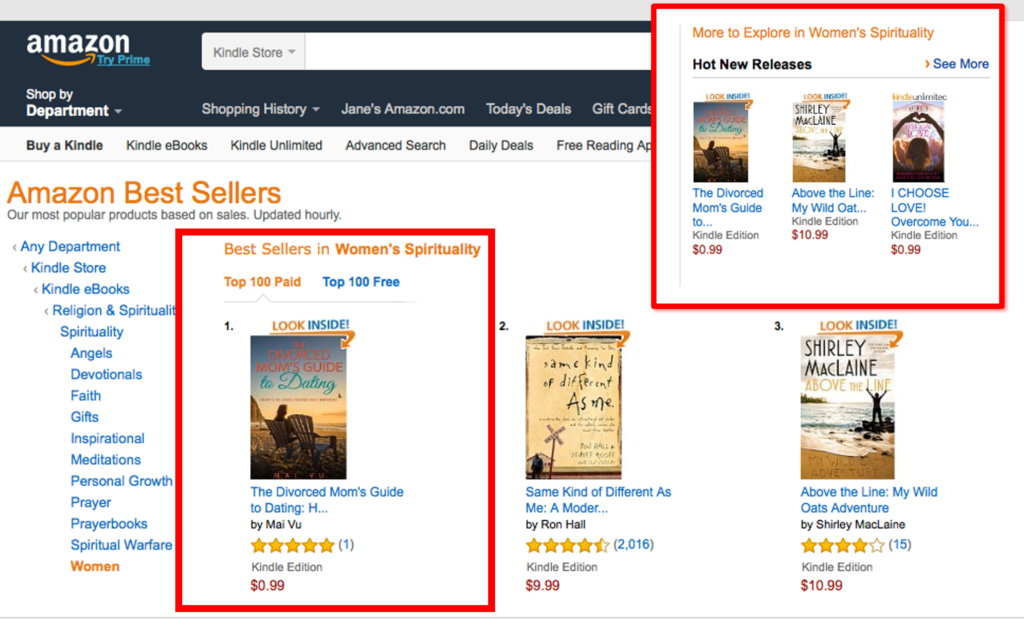


A book launch strategy is a structured, multi-week plan of marketing activities designed to build anticipation, drive early sales, and maximize your book’s visibility before, during, and after publication. The most successful strategies follow the AMPT framework – Audience, Motivation, Profits, and Timeframe – and begin 4-12 weeks before your release date, using coordinated promotions, promotional partnerships, and clear deadlines to create momentum and drive action.
Crafting a successful book launch strategy is an art that merges creativity, strategy, and a deep understanding of your target audience. It’s not just about putting your book out there. It’s about creating an experience, generating anticipation, and engaging with your readers in a way that makes your book not just a publication but an event.
This comprehensive guide to book launch strategy will delve into the essence of running a successful campaign. We’ll outline our proven AMPT strategy: Audience, Motivation, Profits, and Timeframe.
Whether self-published or working with a publisher, you will want to understand what makes a book launch successful. A book launch aims to captivate the author’s intended audience and propel sales to new heights.
What exactly is a book launch? The commonly accepted definition is a range of strategically planned events, activities, and initiatives occurring in the weeks or even months before the release of a new book.
A big part of a successful campaign is getting buy-in. There will be people who will buy your book because they love you and they don’t care if the book’s topic is not of interest to them.
Most prospects will need to know what’s in it for them (WIIFT). The better you can articulate this, the easier it is for prospective readers to realize that your book is precisely what they want and need. For your promotional partners, they’ll want to know what’s in it for their audience — they need to provide value to their audience and understand why that audience will care about your book.
In This Guide to Book Launch Strategy
- What Is a Book Launch Strategy
- Why Most Book Launches Fail
- Focus on Your Author Why
- The AMPT Framework
- Key Elements of a Successful Launch
- How to Plan Your Book Launch Strategy
- Frequently Asked Questions
What Is a Book Launch Strategy?
A book launch strategy is a structured plan of marketing activities designed to build anticipation, drive early sales, and maximize visibility before, during, and after a book’s release.
A strong book launch strategy goes beyond simply publishing your book. It includes audience building, promotional partnerships, and coordinated campaigns that begin weeks or even months before publication.
A typical book launch strategy includes:
- Pre-launch audience building
- Strategic partnerships and promotions
- Coordinated marketing campaigns
- Early sales and visibility efforts
Many authors focus only on publishing their book, but without a clear strategy, even a great book can struggle to gain traction.
While a book launch campaign focuses on execution, a book launch strategy defines the overall plan and direction behind those efforts.
Why Most Book Launches Fail
Many book launches fall short not because the book isn’t good — but because there’s no clear strategy behind it. Authors often focus heavily on writing and publishing, but underestimate what it takes to create visibility, build anticipation, and drive meaningful sales.
Without a well-defined book launch strategy, common challenges include:
- Limited audience awareness before launch
- Unclear messaging about why the book matters
- Lack of coordinated promotional efforts
- Missed opportunities for early momentum
The result is a launch that feels rushed, underwhelming, or quickly forgotten. The most successful book launches, on the other hand, are intentional. They are built around a clear understanding of the audience, a compelling reason to engage, and a structured plan to generate momentum over time.
Focus on Your Author Why
Many authors approach their book launch focused primarily on outcomes — sales, visibility, or recognition. However, the most effective book launch strategies begin with clarity around your deeper purpose.
Why did you write this book? What do you want it to achieve for your readers?
When your “why” is clear, it becomes easier to communicate the value of your book, connect with your audience, and create a launch that feels aligned and compelling.
A strong author “why” strengthens your messaging, your motivation, and your overall impact. Ultimately, your audience is asking one key question: what’s in it for them (WIIFT) — and your “why” helps you answer that clearly and authentically.
The AMPT Framework for a Successful Book Launch Strategy
To create a successful book launch strategy, it’s helpful to follow a clear and proven structure. The AMPT framework focuses on four key elements that drive effective and sustainable results:
| Element | What It Means | Why It Matters |
|---|---|---|
| A – Audience | Who your book is for and how you reach them | The more clearly you define your audience, the more focused and effective your entire launch becomes |
| M – Motivation | Why your audience should care and take action | Strong motivation drives engagement, shares, and ultimately sales |
| P – Profits | How your book supports your broader business or goals | The most successful authors treat their book as an asset, not just a product |
| T – Timeframe | When and how your launch activities are executed | A well-structured timeframe ensures your efforts build on each other rather than happen in isolation |
Each of these elements plays a critical role in building a launch that not only generates initial sales, but also creates long-term value and opportunities.
Audience: Who Is Your Book For?
A successful book launch strategy starts with a clear understanding of your audience. Who is your book for? What challenges are they facing, and what are they actively looking for solutions to?
The more specifically you define your audience, the easier it becomes to create messaging that resonates and to reach them through the right channels. When your audience is clearly defined, your entire launch becomes more focused, efficient, and effective.
Motivation: Why Should Your Audience Care?
Once you know your audience, the next step is understanding what will motivate them to take action. Why should they care about your book? What problem does it solve, or what transformation does it offer?
This is where clarity around messaging becomes critical. Your audience needs to quickly understand the value of your book and why it matters to them. Strong motivation drives engagement, shares, and ultimately, sales.
Profits: How Does Your Book Support Your Broader Goals?
A book launch strategy should align with your broader goals. While book sales are important, many authors benefit even more from the opportunities a book creates — such as speaking engagements, client acquisition, or increased visibility.
Thinking beyond the book itself allows you to design a launch that supports long-term growth, not just short-term results. The most successful authors treat their book as an asset, not just a product.
Authors profit from book launches in non-monetary ways as well. These can include new readers, book reviews, increased shares on social media platforms, and building a list of prospects by requiring their email address when they accept your bonus offers.
Nonfiction authors can generate profits beyond book sales from a constellation of related offerings, including speaking fees, consulting, coaching, and courses.
Timeframe: When and How Should You Execute Your Launch?
Timing plays a critical role in the success of a book launch strategy. Effective launches are not rushed — they are planned and executed over a defined period, often beginning weeks or months before publication.
A book release marketing campaign needs lead time to build momentum and excitement. Launch day or launch week can comprise a series of events springing from the book’s actual release. This can include any number of occasions, such as a book tour, a book launch party, a book signing, an in-person event, and multiple social media posts to boost an author’s online presence.
A well-structured timeframe ensures that your efforts build on each other rather than happening in isolation.
How much time does it take to become a bestseller? Amazon measures sales within a window of a few hours to determine bestseller rankings. The New York Times Bestseller list requires an author to make a minimum of 5,000 book sales in a single week across diverse retailers and from multiple geographic locations.
Key Elements of a Successful Book Launch Strategy
A successful book launch strategy is built on a series of coordinated actions that work together to create visibility, engagement, and momentum. While every launch is different, the most effective strategies tend to include the following key elements:
Audience Building
Building your audience before your book is released is one of the most important factors in a successful launch. This can include growing your email list, engaging your network, and identifying communities where your ideal readers already spend time.
Messaging and Positioning
Clear messaging helps your audience quickly understand why your book matters and why they should care. This includes your book’s promise, the problem it solves, and how it stands out from other books on the topic.
Building Pre-Launch Buzz
The pre-launch phase sets the stage for success. Leverage various platforms — social media, email newsletters, and your website — to tease your audience with captivating snippets, cover reveals, or even author insights. Engage in conversations, create anticipation, and invite your audience to be part of the journey.
Authors sometimes shy away from doing a pre-launch promotion because their book cover isn’t ready or they don’t have their book set up for pre-launch ordering. This shouldn’t stop you as long as you capture interested potential readers’ emails. We recommend setting up a book page on your website or as a standalone landing page.
Promotional Partnerships
Collaborating with others — such as influencers, colleagues, or organizations — can significantly expand your reach. These partnerships help introduce your book to new audiences and build credibility. Your partners can provide valuable social proof to your audiences, who may need to get to know, like, and trust you more.
Find people who already have the attention of your ideal readers. Reach out to fellow authors, even those with books on the same topic.
Cultivating Engagement
Engagement is the heart of every book launch event. Interact with your audience through Q&A sessions, live videos, or interactive social media campaigns. This will create a sense of community and involvement, making your audience feel personally connected to the book and its journey.
I have seen authors cultivate engagement by:
- Sharing cover designs and asking people to vote on them
- Providing updates on the book’s progress — turned in my first draft, got notes back from my editor, just saw the interior layout
- Videotaping themselves seeing the book for the first time — the unboxing when their author copies arrive
Readers love to meet the author, so even if you are camera-shy, consider doing a Facebook Live or using other video content as part of your author platform building.
Launch Timing and Coordination
A well-planned timeframe ensures that your efforts build momentum leading up to your launch. Coordinated activities, such as announcements, promotions, and events, help maximize visibility during this critical period.
Early Sales Strategy
Generating early sales can help boost visibility and create momentum. This may include pre-orders, launch teams, or coordinated purchasing efforts during your launch window.
 Deadlines and Incentives
 Deadlines and Incentives
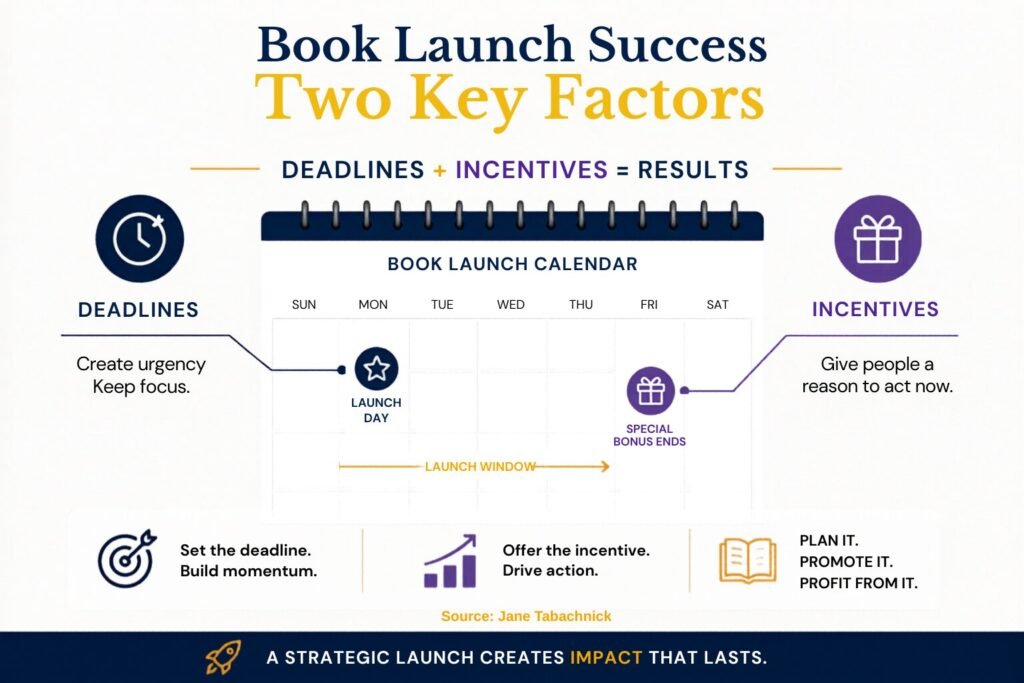
One of the most powerful drivers of action in a book launch strategy is the combination of clear deadlines and meaningful incentives. Without urgency, even interested readers may delay taking action. Deadlines create a reason to act now, while incentives provide additional motivation.
As Jeff Walker, Creator of The Product Launch Formula and New York Times bestselling author, says: “If you want to double your results, double the impact that doubles your income – find a way to put a deadline on your offer. Absolutely a game changer.”
A scientific reason for this is tied to humans’ attraction to pleasure and rewards. The incentive theory of motivation underscores that incentives are the driving force behind motivation. Consumers are naturally attracted to incentives that offer value, such as discounts, complimentary gifts, and time-sensitive offers.
In a book launch, this can take many forms:
- Limited-time bonuses for early buyers
- Launch week incentives or special offers
- Time-sensitive promotions tied to specific dates
- Coordinated campaigns that encourage action within a defined window
Without urgency, even the best book launch strategy can lose momentum. When used effectively, deadlines and incentives help transform interest into immediate engagement – creating the momentum that drives a successful launch.
The Launch Day: Creating an Unforgettable Experience
On the day of your book launch, make it an event. Offer exclusive launch-day discounts, host live events or readings, and encourage your audience to share their experiences and reviews, turning it into a collective celebration.
Sustaining Momentum Post-Launch
Momentum doesn’t end on launch day; it’s about keeping the fire burning. Maintain engagement by sharing user-generated content, behind-the-scenes insights, or even a post-launch “thank you” campaign to acknowledge your supporters. You can also share media coverage or positive reviews of your book.
The key to sustaining momentum and continued success is to use the right tools, such as ad campaigns, Amazon ads, or qualifying for BookBub ads, and to have a consistent post-publication book marketing strategy.
How to Plan Your Book Launch Strategy Step by Step
Creating a successful book launch strategy doesn’t require complexity — but it does require clarity and consistency. By breaking the process into manageable steps, you can build momentum and execute your launch with confidence.
Step 1: Define Your Audience
Start by clearly identifying who your book is for. The more specific you are about your audience, the easier it becomes to craft messaging, choose the right platforms, and connect with readers who are most likely to engage with your book.
Step 2: Clarify Your Message
Your message should clearly communicate what your book is about, who it’s for, and why it matters. Focus on the transformation or outcome your reader will gain, rather than simply describing the content.
Step 3: Build Pre-Launch Momentum
A strong book launch strategy begins before your book is released. This includes engaging your audience, sharing insights from your book, and building anticipation so that readers are ready to take action when your book becomes available.
Step 4: Select Your Book Launch Model
Select the type of book promotion plan best suited to your book, your audience, and your goals. This is especially true for first-time authors. An example of a book launch idea is a simple reduced-price campaign — your ebook would be on sale for $0.99 for a one-day promotion whose goal is to build momentum and achieve Amazon bestseller status. Another model is a bonus-with-purchase book launch campaign, which can be set up as a simple web page or a funnel that walks prospects through the steps of purchasing your book and claiming the bonuses.
Step 5: Coordinate Your Launch Activities
Plan how your promotional efforts will come together during your launch window. This may include announcements, partnerships, events, and coordinated outreach designed to maximize visibility.
Step 6: Track and Adjust
As your launch unfolds, pay attention to what is working. Tracking engagement, sales, and feedback allows you to adjust your approach and extend the momentum beyond your initial launch period.
Frequently Asked Questions About Book Launch Strategy
What is a book launch strategy?
A book launch strategy is a structured plan designed to build anticipation, generate early sales, and maximize visibility before, during, and after your book is released. It includes audience building, promotional partnerships, coordinated campaigns, and a defined timeframe — all working together to create momentum around your book’s publication.
How long should a book launch strategy last?
Most successful book launch strategies begin 4–12 weeks before publication and continue after launch to sustain momentum and visibility. The pre-launch phase is critical for building anticipation and an engaged audience before your book is available for purchase.
What is the difference between a book launch and a book launch strategy?
A book launch refers to the activities and events surrounding a book’s release, while a book launch strategy defines the overall plan, timing, and direction behind those efforts. Think of the launch as the event and the strategy as the roadmap that gets you there.
Do I need a launch team for my book?
A launch team can help amplify your reach, generate early reviews, and build momentum, but it should be part of a broader book launch strategy — not the entire plan. Launch teams are most effective when they are well-briefed, motivated with clear incentives, and supported by coordinated materials.
What is the AMPT framework for book launches?
The AMPT framework is a proven approach to book launch strategy developed by Jane Tabachnick & Co. It stands for Audience (who your book is for), Motivation (why readers should act), Profits (how the book supports your broader goals), and Timeframe (when and how launch activities are executed). Together, these four elements create a focused, effective launch plan.
How do I make my book launch successful?
A successful book launch strategy focuses on understanding your audience, clearly communicating the value your book delivers, creating urgency through deadlines and incentives, leveraging promotional partnerships, and executing a coordinated plan over time — ideally beginning 4–12 weeks before your release date.
How do I build a launch team for my book?
Start by identifying your most engaged readers, colleagues, or community members who genuinely believe in your book. Invite them personally, give them early access to your book, and provide clear, easy-to-follow instructions for how they can help. The more supported and appreciated your team feels, the more enthusiastic their participation will be.
Ready to put your book launch strategy into action? Easy Book Launch is an AI-powered tool that helps you strategize your launch, build your campaign plan, and writes your email copy and social media posts – all in one place.
Want to keep the momentum going after launch day? The Author Content Engine interviews you like a podcast, then automatically generates blog posts, social media content, and more – so you never run out of fresh content to keep readers engaged.
Conclusion: A Launch Beyond a Book
Running a successful book launch campaign isn’t just about selling a book; it’s about creating an experience. It’s about building a community, a relationship with your audience that extends far beyond the launch day.
By focusing on your Audience, Motivation, Profits, and Timeframe through the AMPT framework, you can turn a simple book launch into an unforgettable experience for your readers – and a profitable one for you.
Remember, the success of a book launch campaign isn’t solely measured in sales figures. It’s also about the connections you build, the impact you make, and the journey you embark on with your audience. Embrace the creativity, utilize the AMPT strategy, and watch your book launch soar to new heights.
In the next post, I’ll outline our Perpetual Profitable Launch Strategy.
Sounds like hard work? It doesn’t need to be! Want expert help on your book launch? We offer Book Launch Campaigns done-for-you. Our new Bestseller Book Launch Lab is an excellent way for new authors to get expert book launch training while designing and building a successful bestseller book launch campaign done-with-you. More information coming soo