

 How to Turn Your Expertise Into a Nonfiction Book
Turning your expertise into a nonfiction book starts with recognizing that your knowledge already has value – the challenge is structuring it into something readers can use, trust, and act on. A nonfiction book built from real expertise doesn’t just share information – it positions you as a trusted authority, generates leads, opens speaking and media doors, and works for your business long after it’s published.
This guide walks you through the process from idea to published book, based on years of working with consultants, coaches, and entrepreneurs who’ve made the leap from expert to author.
Why Your Expertise Deserves a Book
You don’t need to be famous to write a book. You need to have helped real people solve real problems. If you’ve built systems that work, developed frameworks your clients rely on, or spent years mastering something most people struggle with, you already have the foundation for a nonfiction book.
A book is a credibility engine. It shows up in search results, positions you as a thought leader, and gives readers one-on-one time with your voice and insights before they ever speak to you directly. In a world of rising skepticism and AI-driven discovery, nothing builds trust faster than being a published author. Your book signals long-form, structured expertise – the kind that unlocks media quotes, podcast spots, speaking invitations, and the kind of citations that AI systems recognize and amplify.
Beyond the business case, writing a book transforms you internally. It builds resilience, teaches you to ask for support, and puts you in an uncomfortable-but-growth-inducing spotlight. Becoming an author is like joining an exclusive club – and stepping into that circle, while terrifying, is something you won’t regret.
Step 1: Clarify Your Book Idea Before You Write a Word
The most common mistake aspiring authors make is diving straight into writing. Before you type a single sentence, you need clarity on three things: what your book is about, who it’s for, and why it matters.
Any topic can be turned into a book. But knowing whether your idea has a market – and aligns with your business goals – is essential. Many aspiring authors come to me with a tangle of ideas and aren’t sure which one to write, or they have loose concepts but don’t know how to connect them cohesively.
This is where a Book Blueprint comes in. Before writing a single word, bestselling authors create a book proposal – and for self-publishers, the equivalent is a Book Blueprint. This foundational document covers your book’s purpose, ideal reader, competitive positioning, and a strong outline. It eliminates writer’s block and gives you a clear roadmap to follow from start to finish.
In my work with authors, we use the Book Blueprint process – the same process used by New York Times and USA Today bestselling authors – to get complete clarity before any writing begins. Participants who walked in unsure have walked out with clarity, direction, and excitement about the book they’re going to write.
👉 Learn more about the Book Blueprint process
Step 2: Define Your Ideal Reader
A nonfiction book that tries to speak to everyone ends up resonating with no one. The more precisely you define your ideal reader, the more powerful your book becomes.
Using tools like Answer The Public, client interviews, and careful listening, you can capture your reader’s exact language, fears, and desires – then speak directly to them. That deep resonance is what turns readers into raving fans and pre-sells them on working with you.
Think about the transformation your reader will experience. Business books that succeed typically solve one clear problem for a specific audience. Instead of writing broadly about your entire field, focus on the one thing you can help your reader achieve – and build every chapter around getting them there.
Your clients are the recipients of your expertise and knowledge, so start with them. What questions do they ask you most often? What problems do they bring to you again and again? Those patterns are the skeleton of your book.
Step 3: Choose the Right Book Format
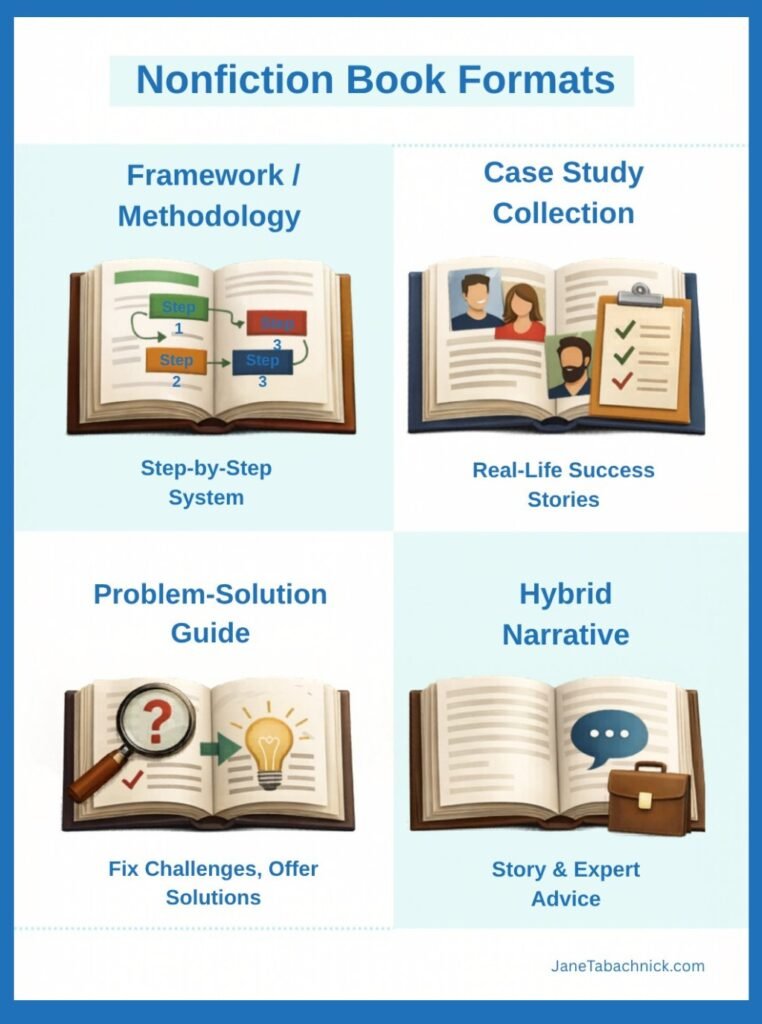
A methodology doesn’t have to be twelve chapters. Your book could be a parable, a case study collection, a step-by-step guide, or even a short fifty-page book.
The right format aligns with your zone of genius, your reader’s needs, and feels the least like labor to create.
Here are the most common nonfiction formats for expertise-based books:
- Framework or methodology book – walks readers through your proven system step by step.
- Case study collection – demonstrates your approach through real client stories and outcomes.
- Problem-solution guide – addresses the top challenges your audience faces with actionable solutions.
- Hybrid narrative – blends personal story with professional insight and practical advice.
The format you choose should match both your natural communication style and your reader’s preferred learning style. Some audiences want a linear roadmap. Others want to see themselves in stories before they trust the advice.
Step 4: Build Your Outline and Write Strategically
With your idea clarified, your reader defined, and your format chosen, it’s time to build a detailed outline. A good outline breaks the entire project into manageable pieces and makes the path forward feel doable.
Having a plan reduces overwhelm and stress – and prevents the wandering, unfocused drafts that kill momentum.
Your outline should cover the transformation arc from where your reader starts to where they end up. Every chapter should serve a clear purpose within that arc. If a chapter doesn’t move the reader closer to the promised transformation, it doesn’t belong.
Here are a few strategic writing principles that make expertise-based books stronger:
- Include stories. Stories are how our brains are wired to learn and remember. Including well-chosen client stories in your nonfiction book demonstrates your methodology in action, provides social proof, and helps readers see themselves in your work and imagine the transformation you can create for them.
- Find your voice. Every author has a unique voice – the challenge is finding and trusting it. Your author voice is your fingerprint in writing. Know your audience, write regularly, be authentic, include personal stories, and don’t be afraid to share your opinions. The most powerful books make readers feel like they were written just for them, which requires depth, honesty, and genuine empathy.
- Write useful books. Treat your book like a product. Gather reader feedback early, share behind-the-scenes of the process, and iterate based on what readers actually need. Books built with readers get recommended. Books written in isolation often miss the mark.
Step 5: Don’t Write Your Book Alone
Going solo on your book has hidden costs: lost time, frustration, burnout, and unfinished manuscripts. Many authors start strong and stall out – not because the idea is weak, but because the process is isolating and overwhelming without the right support.
My client Frederica Peterson, a leadership and diversity consultant, knows this firsthand. She had the expertise and the drive, but spent time going in circles trying to get her book done on her own. Once we started working together, everything shifted.
Thanks to the structure, strategy, and guidance we built around her project, Frederica’s book is now used as a tool in a training program at AT&T, she’s been tapped as a top trainer by the Tony Robbins organization, and she’s become a sought-after thought leader in her field. As she puts it:
“Jane’s knowledge in this arena is exceptional and her excitement genuine. I wanted very much to have a #1 best-seller and with Jane’s help and guidance we achieved that goal!”
I’ve experienced the power of community and coaching firsthand myself – not with a book, but with building a technical product that required building a funnel with an automation sequence. Twice now, I’ve joined a group coaching program and formed a mini cohort with other participants.
That small group provided accountability, honest feedback, friendship, and camaraderie – and when it came time to launch, they became my built-in launch team.
I wouldn’t have finished either project without that structure and support.
Writing a book works the same way. The authors I work with who finish fastest and produce the strongest books are almost never the ones who go it alone.
There are several types of author support available, and understanding the difference matters:
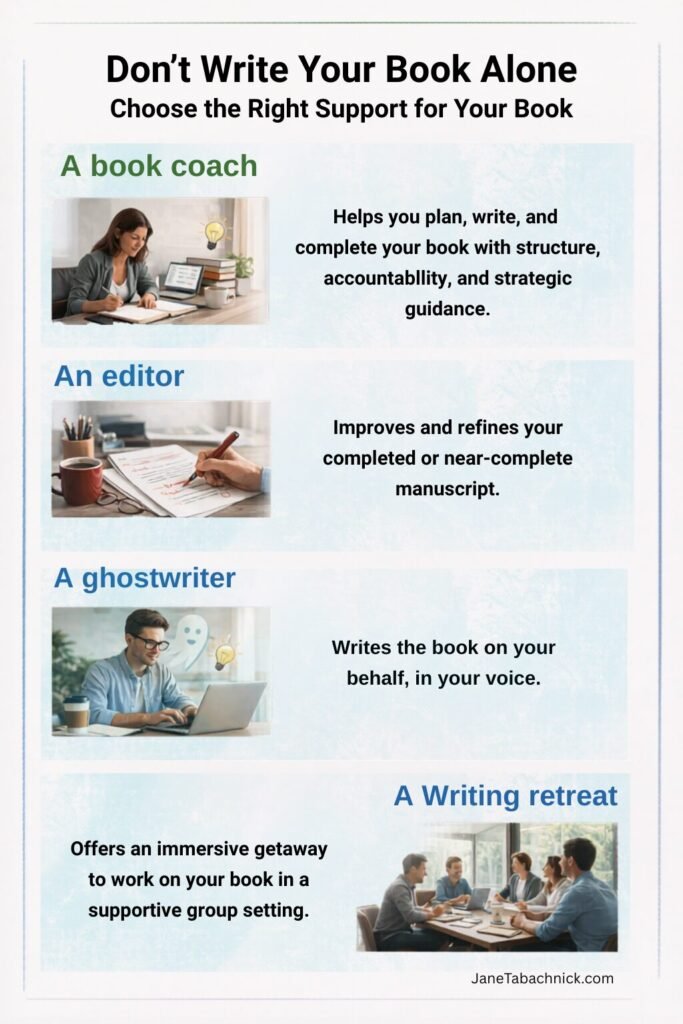
- A book coach helps you plan, write, and complete your book with structure, accountability, and strategic guidance.
Some coaches focus only on the manuscript. Others – like my approach – cover the full journey from idea through publishing, launch, and positioning your book as a business tool.
- An editor improves and refines a completed or near-complete manuscript.
Many authors benefit from a coach first, then an editor once the draft is complete.
- A ghostwriter writes the book on your behalf, in your voice.
This is ideal for experts who have the knowledge but not the time or desire to write it themselves.
- A Writing retreat is an immersive experience where you step away from your daily routine to focus entirely on your book with expert guidance and a small group of fellow authors.
Retreats build accountability, spark breakthroughs, and create an instant community that often becomes your launch team.
👉 Explore Jane’s book coaching services
Step 6: Think About Marketing Before You Finish Writing
Most authors disappear during writing, then surface two weeks before launch, asking for shares – and that approach rarely works. A book launch is not an event. It’s the outcome of months of relationship-building.
Here are pre-launch marketing actions to take while you’re still writing:
- Build your email list. Start collecting readers and supporters now, not after the book is published. Organize them into lists, so they are ready for your launch when your book is completed.
- Nurture relationships early. Top podcasts book guests five or more months out. Start building relationships with journalists, podcast hosts, influencers, and peers while you’re still drafting chapters.
- Organize your contacts. Create a media list and a list of potential launch partners well in advance.
- Claim your author identity now. You don’t have to wait until your book is published to call yourself an author. If you’re writing, you already are one. Claiming the identity early and speaking about it shifts your mindset, builds community, and invites speaking and podcast opportunities before the book is even out.
Something surprising happens when you publicly commit to writing your book: opportunities start finding you. Podcast invites, speaking gigs, and new connections tend to flood in. Declare your intention publicly, and watch the momentum build before the book is even finished.
Step 7: Publish Strategically
Anyone can upload a file to Amazon, but publishing professionally is far more nuanced. The publishing path you choose should match your goals, your timeline, and the experience you want your reader to have.
The main publishing paths for nonfiction authors include traditional publishing, hybrid publishing, and self-publishing in various forms – from DIY to professional self-publishing with a full team behind you. Each comes with different tradeoffs in terms of cost, control, time, and quality. The right choice depends on how you value your time, how much guidance you need, and what result you’re aiming for.
Whatever path you choose, don’t overlook discoverability. Your book’s metadata – title, subtitle, categories, keywords, and description – determines whether readers find you. Amazon optimization is critical, and knowing what to focus on makes all the difference for author success.
And remember: your book is a business asset, not a bestseller competition. For most nonfiction authors, especially entrepreneurs, consultants, and coaches, the real return on a book isn’t measured in copies sold. It’s measured in the client leads it generates, the speaking opportunities it opens, the media exposure it creates, and the consulting engagements it attracts.
Step 8: Position Your Book as an Authority Asset
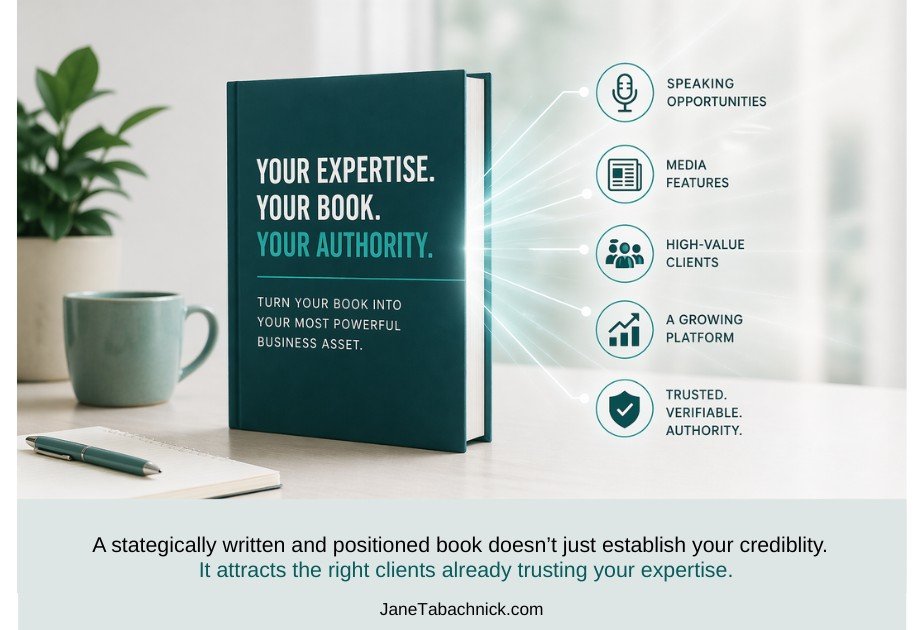 A book isn’t just a product – it’s one of the most powerful authority assets you can create. When your book is strategically built from the ground up, it becomes a calling card that opens doors long after it’s published: media opportunities, speaking engagements, high-value client relationships, and a growing platform.
In an AI-driven world, being a trusted result is far more valuable than simply being visible. AI search favors trusted, verifiable, well-cited sources – and authors benefit enormously. A published book signals the kind of structured expertise that AI systems recognize and amplify, making you more discoverable in the very search environments where your ideal clients are looking.
The difference between a book that collects digital dust and one that actively builds your business almost always comes down to strategy. Every book I work on goes through a process I call Seeding the Content – a deliberate strategy to ensure your book functions as a powerful marketing tool, not just a well-written read.
A strategically written and positioned book doesn’t just establish your credibility. It creates a steady stream of leads who arrive already trusting your expertise. That’s the kind of book worth writing.
Ready to turn your expertise into a book that builds your business?
Frequently Asked Questions
How do I know if my expertise is enough for a book?
If you’ve helped real people solve real problems and have frameworks, methods, or insights that others rely on, you have enough for a book. You don’t need decades of experience or a PhD – you need a clear message and a defined audience.
How long does it take to write a nonfiction book?
Most nonfiction authors working with a coach complete their manuscript in six to twelve months, depending on their availability and the complexity of the topic. Having a clear Book Blueprint and accountability support significantly reduces the time most authors spend stuck or starting over.
Should I self-publish or pursue traditional publishing?
It depends on your goals. Self-publishing offers speed, control, and higher royalties. Traditional publishing offers prestige and distribution but slower timelines. Many nonfiction authors – especially those using their book as a business tool – find that professional self-publishing gives them the best combination of quality and control.
Do I need to be a good writer to write a book?
Writing is a skill built through practice, not natural talent. You can develop your writing through the process itself, work with a writing coach, or hire a ghostwriter. The most important thing is that your expertise and ideas come through clearly.
How do I turn my book into business results?
Build your book strategically from day one – with your ideal client, your business goals, and your positioning in mind. A book that’s written as an authority asset generates leads, speaking opportunities, media coverage, and client trust that far exceed its sales revenue.
Can I start marketing my book before it’s finished?
Yes – and you should. Building your email list, nurturing relationships, creating a media list, and claiming your author identity while you’re still writing gives you the momentum you need for a successful launch.
What’s the difference between a book coach and an editor?
A book coach helps you plan, write, and complete your book with structure, accountability, and strategic guidance – often covering the full journey from idea through launch. An editor improves and refines a manuscript that’s already written. Many authors work with a coach first, then an editor.